AMD’s operating results and its share price are telling different stories. At 10:17 a.m. EST on November 6, shares were $445.84, up 10.25% from Thursday’s close, according to Nasdaq’s quote service. The rebound follows a 17.26% decline on November 5. It restores some confidence in demand for the stock, but leaves a large gap to the trend that existed before the selloff.
- Data-center growth is the clearest support for AMD’s operating outlook.
- Rising quarterly profit does not mean that every business or margin measure improved.
- The stock’s recovery still needs confirmation from subsequent closes and delivery against guidance.
The earnings engine is increasingly data-center led
AMD designs processors and accelerators for servers, PCs and other computing applications. Its opportunity is broader than one AI product, but that breadth also means that strength in one segment can coexist with weakness elsewhere. Investors need to distinguish growth from a changing sales mix from growth spread evenly across the business.
In its November 3 earnings release, AMD reported Q3 revenue of $13.377 billion and GAAP net income of $2.428 billion. GAAP diluted EPS was $1.46, compared with adjusted EPS of $2.09. Data-center revenue rose 97% year over year to approximately $8.5 billion, while combined Client and Gaming revenue fell 8%.
For Q4, management expects approximately $17 billion of revenue, plus or minus 3%, and an adjusted gross margin near 55%. That outlook implies a substantial further step in sales, but remains a forecast. The main operating question is how efficiently the company can translate the expected expansion into earnings and cash.
Four quarters reveal a more nuanced margin picture
The platform’s recorded revenue sequence is $10.27 billion in Q4 2025, $10.253 billion in Q1 2026, $11.536 billion in Q2 and $13.377 billion in Q3. The latest quarter therefore extends a clear recovery from the comparatively flat start to the year. Earnings also rose, from $1.383 billion in Q1 to $2.297 billion in Q2 and $2.428 billion in Q3.
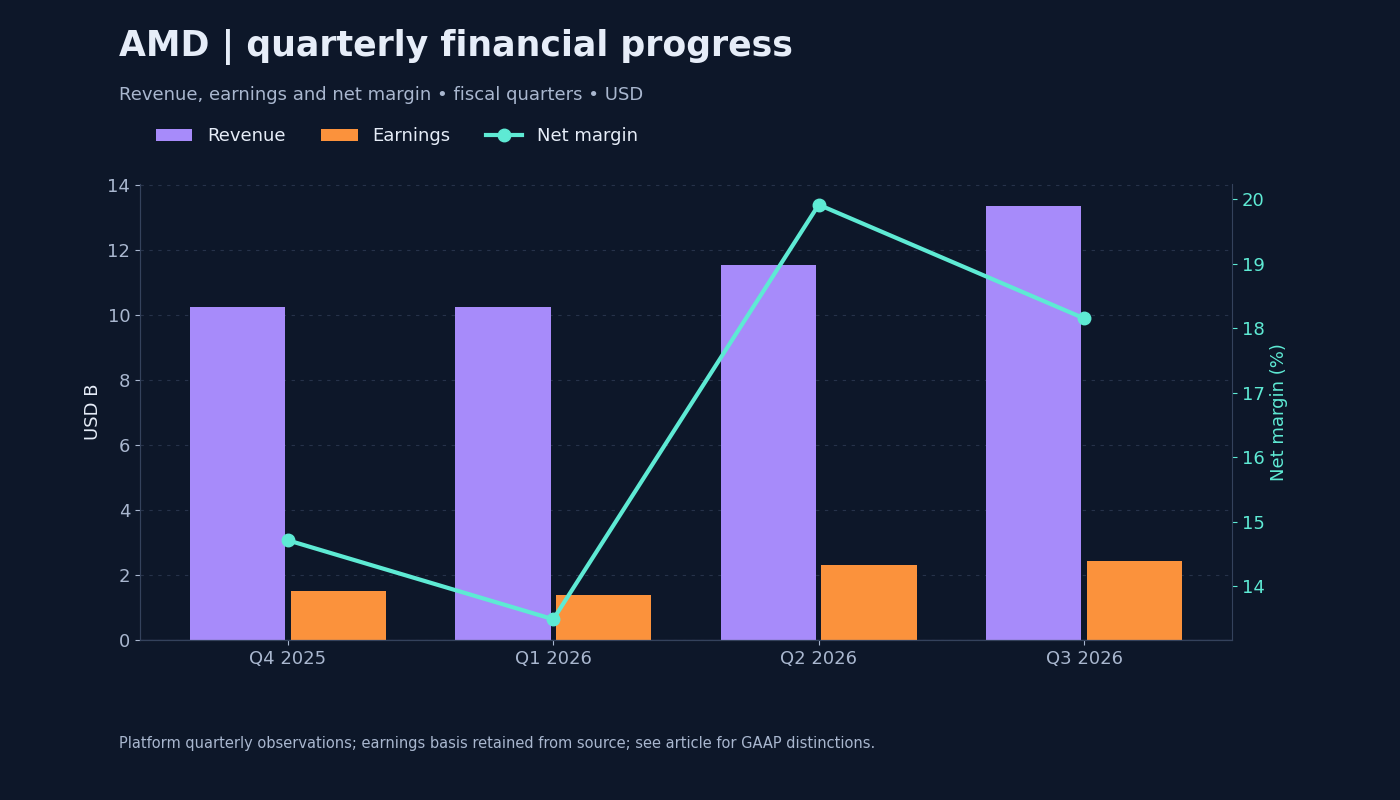
However, the associated net margin declined from approximately 19.9% in Q2 to 18.2% in Q3. The earnings increase was smaller than the sales increase. That does not negate the growth case, but it makes margin conversion a more useful next check than simply repeating the latest revenue record. The chart uses fiscal-quarter labels rather than asserting calendar month-end dates as exact fiscal period ends.
The normalized EPS sequence was $1.53, $1.37, $1.66 and $2.09. It should remain separate from GAAP diluted EPS. A valuation argument based on adjusted earnings needs to acknowledge the adjustment basis; comparing one company’s adjusted multiple with another’s GAAP multiple would create false precision.
Two factors support the business thesis: expanding data-center sales and a forecast for another substantial sequential increase. Two risks balance them: dependence on converting that outlook into delivered systems and the possibility that competition or a less favorable mix limits profitability. Investors should also resist treating all end markets as equally strong when the reported segments differ.
Why Friday’s gain is not yet a trend reversal
AMD closed November 5 at $404.40 and had lost 28.60% across five trading-session intervals. Its recorded 50-session average was approximately $547.37. Even after Friday’s recovery, the quoted price remained about 18.5% below that reference.
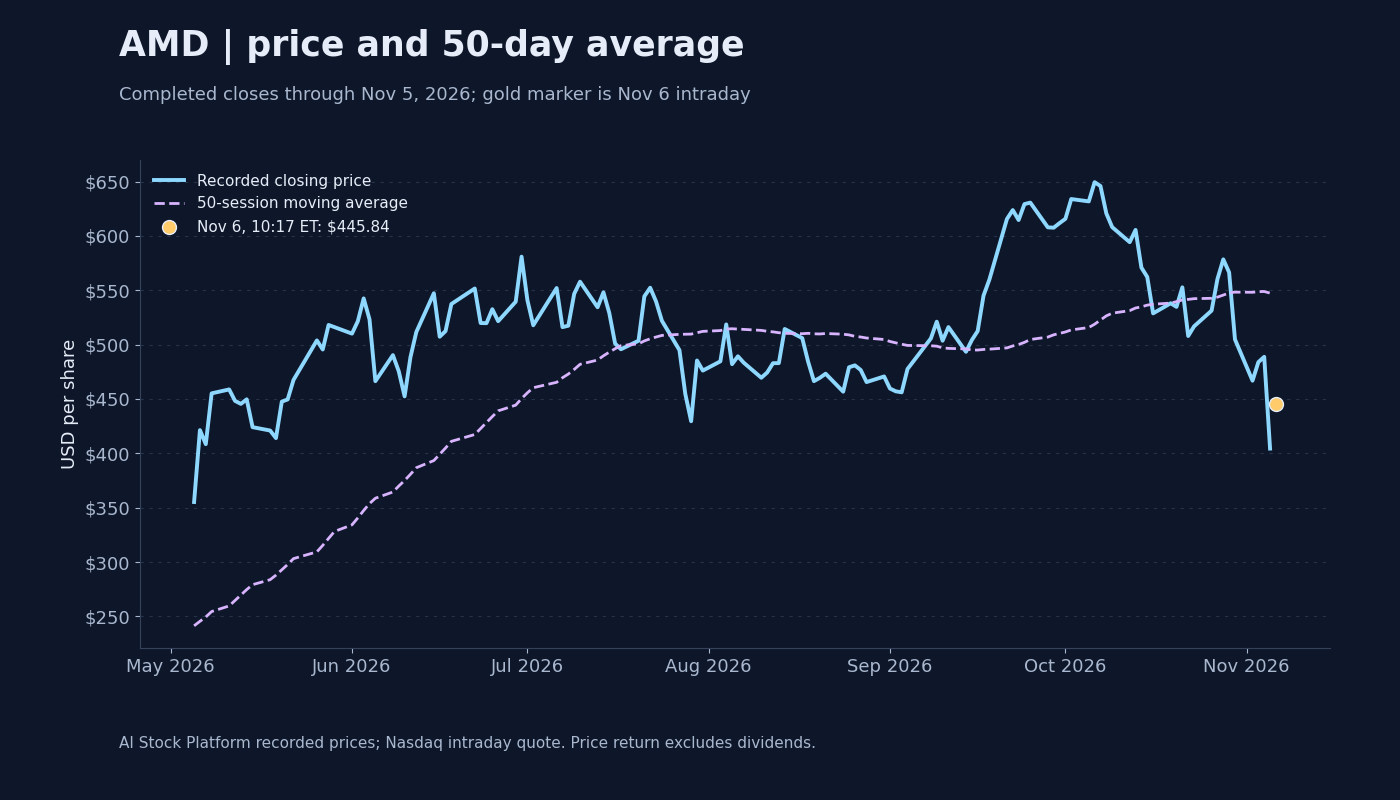
The platform’s one-year closing range was $190.95 to $649.42. Friday’s price was approximately 55.6% of the way up that range. AMD has retreated substantially from its high, but it is not trading near the bottom of that recorded annual range. Exchange 52-week ranges using intraday extremes will show different boundaries.
For a recovery thesis, a sequence of steadier closes would provide more evidence than one sharp percentage rebound. Moving back toward the average while maintaining gains would improve the price structure. Repeatedly surrendering rallies would leave the stock dependent on fresh positive news to offset persistent selling.
The semiconductor backdrop remains relevant. The platform’s research index fell 12.71% on November 5, and the broader industry had four advancing stocks against 90 declining stocks among available comparisons. Those figures describe the completed session, not Friday’s live industry performance. Broad weakness can overwhelm an individual earnings story for longer than a single session.
Ratings explain the gap between growth and price behavior
The November 5 Price Score was 2.28/5, labeled Weak, up 0.08 from the preceding session. Momentum V3 declined from approximately 48.61 to 46.96 on its 0–100 scale. The latest model snapshot’s AI Score was 2.23/5. The small Price Score improvement therefore did not represent a broad strengthening across all signals.
The current Price Score formula gives more points to prices below the 50-DMA, but also accounts for weekly returns, industry sentiment, annual-range position and rank movement. Falling below an average is only one input. Momentum measures a different aspect of price behavior, and the AI Score is a separate model assessment. These are research signals, not live earnings forecasts or analyst recommendations.
Peers and the next operating checkpoint
Nvidia and Intel illustrate the range of outcomes within processors and computing infrastructure. Their completed-session Momentum readings were approximately 54.36 and 45.81 respectively, compared with AMD’s 46.96. Product exposure and business economics differ, so those readings are price context rather than a ranking of their technologies or fair values.
AMD’s investor calendar lists appearances at the UBS technology conference on December 1 and Barclays’ technology conference on December 9. They are potential management-update opportunities, not earnings releases; presentation times are not assumed here.
The assessment is constructive on data-center demand, cautious about assuming the stock is repaired. Delivery against Q4 revenue guidance and better conversion into shareholder earnings would support the operating case. Sustained closes would support the price case. A shortfall in either would leave Friday’s bounce looking more like relief than a durable change in direction.