
Ameresco’s growth case has gained fresh operating support from a larger backlog and an improvement in reported earnings. The investment opportunity is to follow the conversion of that work into completed projects and cash, rather than treating the headline value of future business as revenue already earned.
Ameresco (AMRC) is a current Bull Portfolio holding, selected for identified short-term growth potential. The basket became effective on November 9. Its selection reflected an earlier recovery setup; subsequent price appreciation does not mean the share must still meet every original entry-screen threshold today.
Key takeaways
- A larger backlog adds substance to the growth opportunity.
- Normalized EPS must remain separate from statutory EPS.
- The recent rally shifts attention toward project and cash conversion.
Backlog gives the recovery a business foundation
Ameresco develops energy infrastructure and efficiency projects and operates energy-related assets. Its opportunity combines customer investment in better infrastructure with the potential for ongoing operating and maintenance activity. The attractive version of the thesis is a pipeline of work that becomes productive assets and repeat business, supported by disciplined project execution.
A project business requires a different reading from a subscription platform. The timing of contracting, construction and customer acceptance can affect individual quarters, while financing and working capital can separate reported profit from immediate cash generation. Strong demand is useful, but the investor ultimately needs evidence that delivery is economically attractive.
The November 9 results release reported Q3 revenue of $580.3 million, common-shareholder net income of $31.9 million, GAAP EPS of $0.59 and non-GAAP EPS of $0.88. Total project backlog reached approximately $7.2 billion. The company distinguished awarded work from contracted backlog and explained accounting changes involving tax credits and joint ventures. Those qualifications are essential when interpreting the growth figures.
A return to stronger earnings conversion
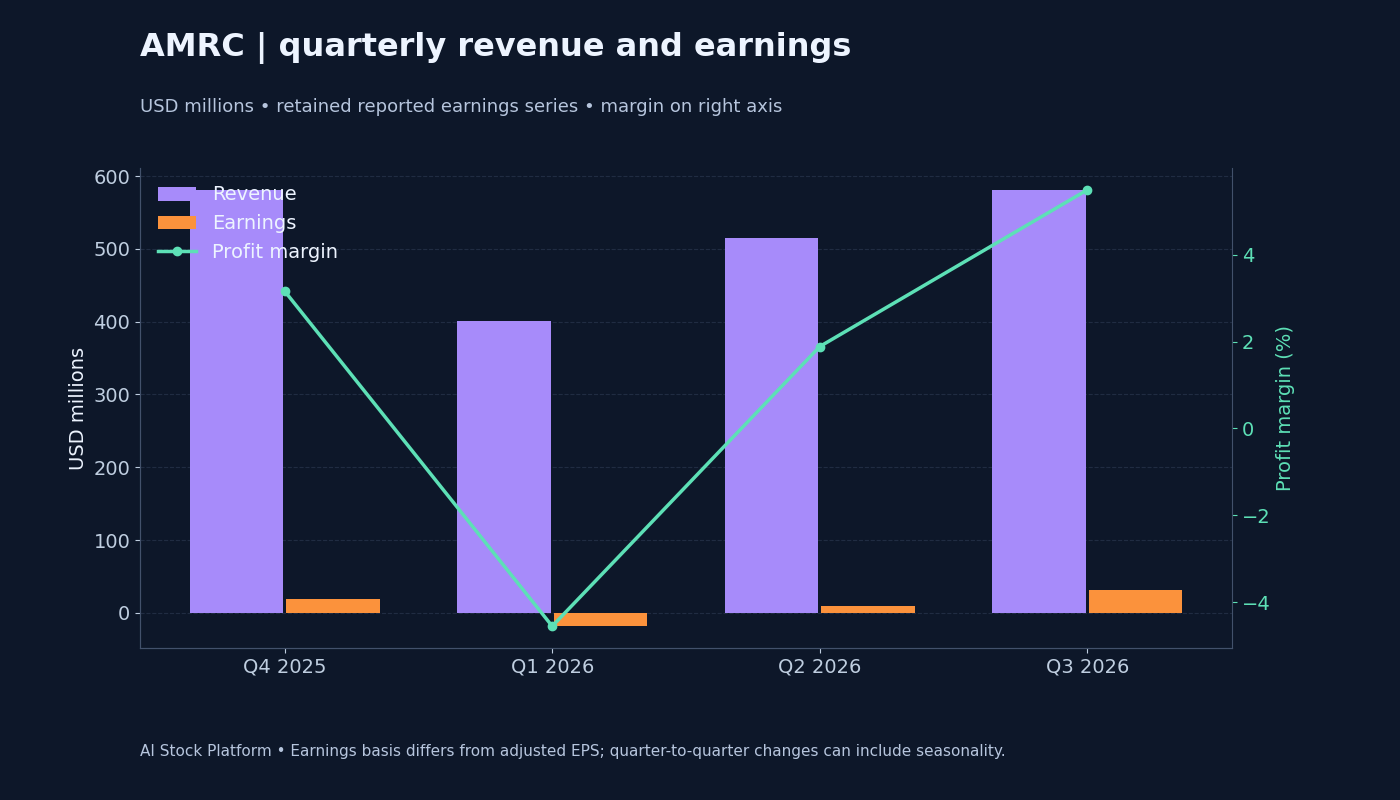
The retained quarterly revenue series is $581.026 million, $401.460 million, $515.464 million and $580.315 million from Q4 2025 to Q3 2026. Reported earnings for the matching observations are $18.371 million, a loss of $18.283 million, $9.718 million and $31.881 million. The latest matched margin is approximately 5.49%, compared with 1.89% in Q2.
That sequence gives the recovery a visible financial dimension: the business has moved from a loss in the March quarter to stronger earnings on a larger revenue base. It does not establish that every quarterly change is organic or that accounting adjustments have no influence. A useful next step is to inspect the quality of conversion alongside the scale of work being won.
Normalized EPS in the retained series moves from $0.39 to minus $0.33, $0.20 and $0.88. The latest normalized observation corresponds to the issuer’s non-GAAP figure, not its $0.59 GAAP EPS. Keeping the two separate prevents an attractive recovery narrative from becoming an exaggerated claim about statutory profitability.
Price progress and the room for confirmation
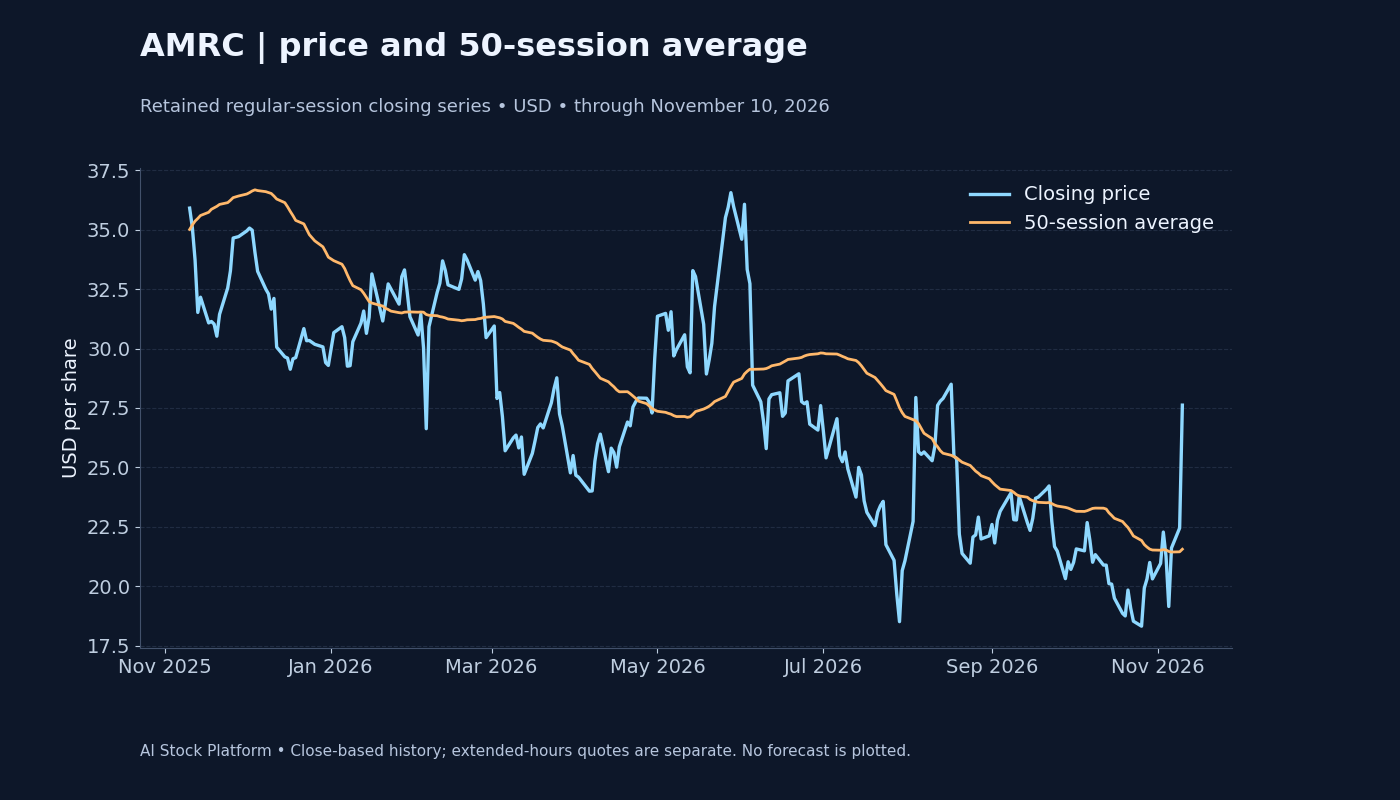
The latest exchange premarket quote was $28.08, +1.67%, at Nov 11, 2026 4:17 AM ET. Early-session trades can occur on limited volume and are separate from completed-session returns. The platform’s retained November 10 closing series records $27.62, a +23.03% daily change and a +23.97% five-session return. The price chart and all historical comparisons use that same retained series.
The annual closing-price range is $18.32–$36.56, placing the latest retained close approximately 51.0% of the way from its low to its high. This is a range position, not the one-year return, and it differs from an intraday 52-week high/low. The 50-session average is $21.56; the close stands +28.11% relative to it.
Ameresco’s recent rise has lifted it beyond the low-range setup that originally made it interesting for a recovery screen. That is encouraging as evidence of market recognition. It also changes the practical research question from identifying neglected potential to assessing whether operating delivery can support the price now being paid.
Three signals ask different questions
The current Price Score is 3.08/5, Momentum V3 is 47.23/100, and AI Score is 2.56/5. Price Score describes a recovery-oriented setup, including weekly return, distance from the moving average, industry sentiment, annual-range position and rank movement. It is not a business valuation or an analyst recommendation.
Momentum V3 changed by +1.57 points between the November 9 and November 10 price-feature observations. The AI snapshot is dated November 11, while the Price Score and momentum features refer to November 10. Different scores can disagree because they measure different things; no model probability or price target is inferred from these readings.
The platform’s 20-stock illustrative industry index shows a -0.15% five-session move and stands +3.97% relative to its own 50-session average. That describes the broader group’s backdrop, not this company’s return. A stronger business case is easier to sustain when company delivery and industry participation reinforce each other.
Fluence and Nextracker are relevant energy-infrastructure reference points rather than direct substitutes for Ameresco’s full project mix. Their current platform Price Scores are 3.08 and 2.64, compared with AMRC’s 3.08. Momentum V3 is 44.68 for FLNC and 49.68 for NXT, versus 47.23 for AMRC. Different industry assignments and business models limit a simple league-table interpretation.
Cash conversion is the next growth checkpoint
The positive drivers are a larger opportunity set and better recent earnings conversion. To strengthen the thesis, future updates should show that awarded work becomes enforceable contracts, projects progress and the financial benefit reaches cash generation. Backlog provides visibility, but it should not be valued as though every dollar is already collected.
The main inhibitors are delays, cost overruns and financing needs that absorb the benefit of growth. Accounting comparability also deserves continued attention. The constructive assessment is that the recovery now has measurable business support; further upside would be better grounded in execution and cash than in another isolated expansion of the backlog headline.