
Three things to know
- Assembly Biosciences is a Bull Portfolio selection for short-term growth, with a 1.44% completed-week gain.
- Friday’s $20.42 close, up 2.10% that session, remained the latest verified trade in the available quote; no November 9 trade was confirmed.
- A November 10 investor conference is a near-term event, while initial results from the newly started HDV Phase 2 study are expected in late 2027.
Assembly Biosciences enters the week with an active antiviral development program and an opportunity to bring its pipeline progress to a wider investor audience. Its share-price position near the lower end of the annual closing range, together with a positive completed week, makes the recovery setup relevant for investors looking for emerging growth opportunities.
ASMB is part of the public Bull Portfolio, selected because the November 6 screen identified short-term growth potential across recent returns, price location, EPS comparison and trading participation. The November 10 conference offers a near-term opportunity to follow management’s development priorities, while the newly started HDV Phase 2 study provides a longer-term clinical milestone to track.
What has actually changed
Assembly develops medicines for serious viral and liver diseases. Its commercial opportunity depends on research progress and collaboration economics, rather than a broad base of established product sales. That makes trial design, funding and partner decisions especially important when interpreting quarterly financial changes.
On October 29, the company announced dosing of the first two participants in its Phase 2 study of oral NTCP inhibitor ABI-6250 for chronic hepatitis delta virus. Approximately 80 participants are expected, with initial data anticipated in Q4 2027. Starting the study is a confirmed milestone; evidence of patient benefit remains to be established. Company trial announcement
For this week, the company’s calendar lists a Guggenheim Healthcare Innovation Conference appearance on November 10 at 2 p.m. EST. That may provide context and investor access, but the listing does not promise new clinical data. The conference should therefore be monitored for what is actually disclosed, rather than treated as a scheduled earnings beat. Issuer events calendar
A small weekly gain inside a weaker month
ASMB’s five-session return was positive 1.44%, while its one-month return remained negative 10.52%. The latest close of $20.42 stood 17.10% below its $24.63 50-session moving average. That is a substantial trend gap even after a positive week.
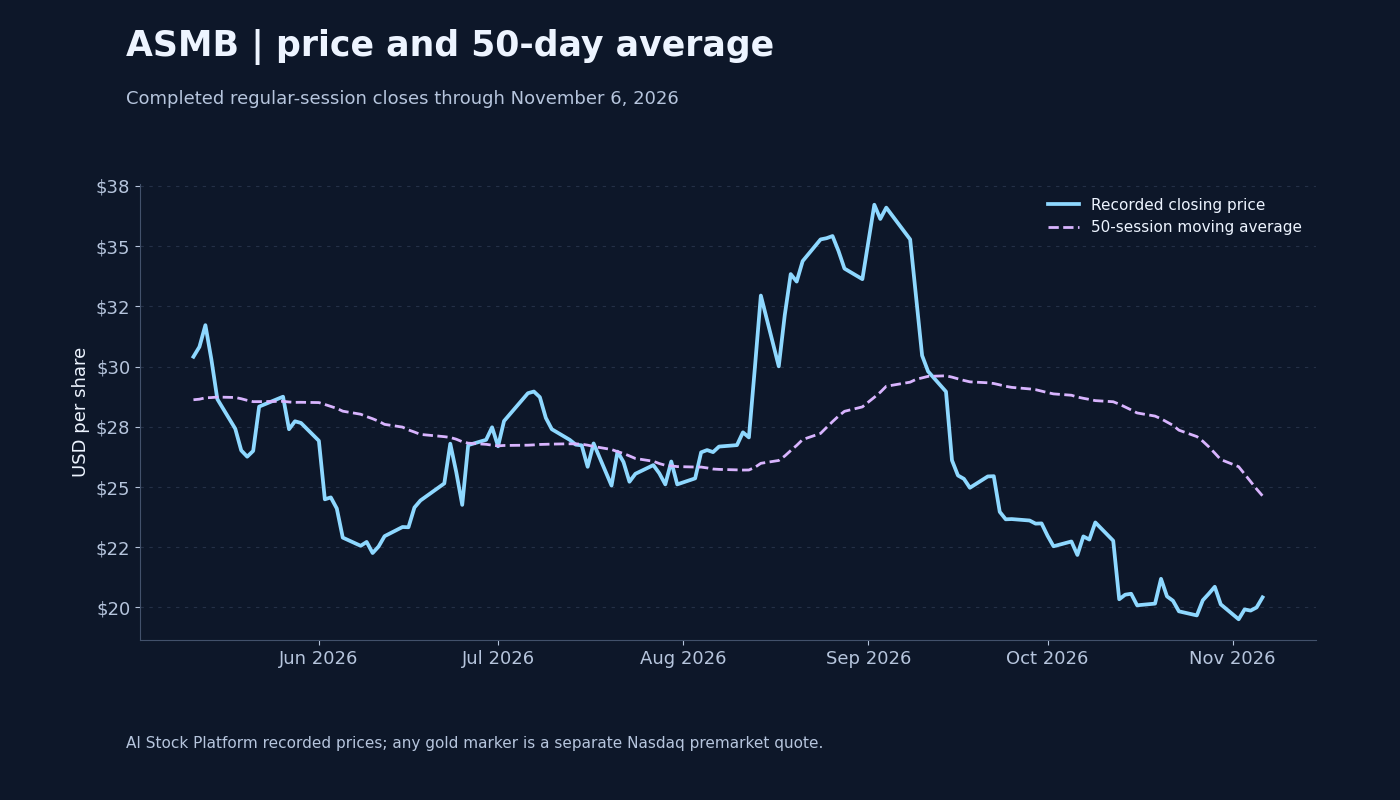
The platform’s annual closing range was $19.51–$38.50. Friday’s price occupied only about 4.8% of that range, making this one of the more depressed chart locations among the five featured Bull selections. The range describes historical trading, not the value of the pipeline or a floor under future losses.
Volume supplied a more encouraging sign: the latest five-session average was 1.41 times the preceding, non-overlapping 20-session average. A recovery with increased attention has more support than one based solely on an isolated price tick. Even so, volume cannot identify the motives of buyers and sellers or guarantee continued demand.
The first practical test is whether regular-session trading can maintain the recent closing floor while making progress through nearby selling pressure. A quick break to new lows would weaken the setup. Expecting the stock to recover its entire moving-average gap in one week would set a much stronger requirement than the screen itself.
EPS improved, but recurring profitability is unproven
The stored normalized EPS sequence was negative $0.72, positive $2.48, negative $0.54 and negative $0.20 across the latest four quarters. The most recent loss narrowed, which supported eligibility. The unusually positive earlier quarter means this is not a smooth progression toward profitability, and it should not be extrapolated as one.
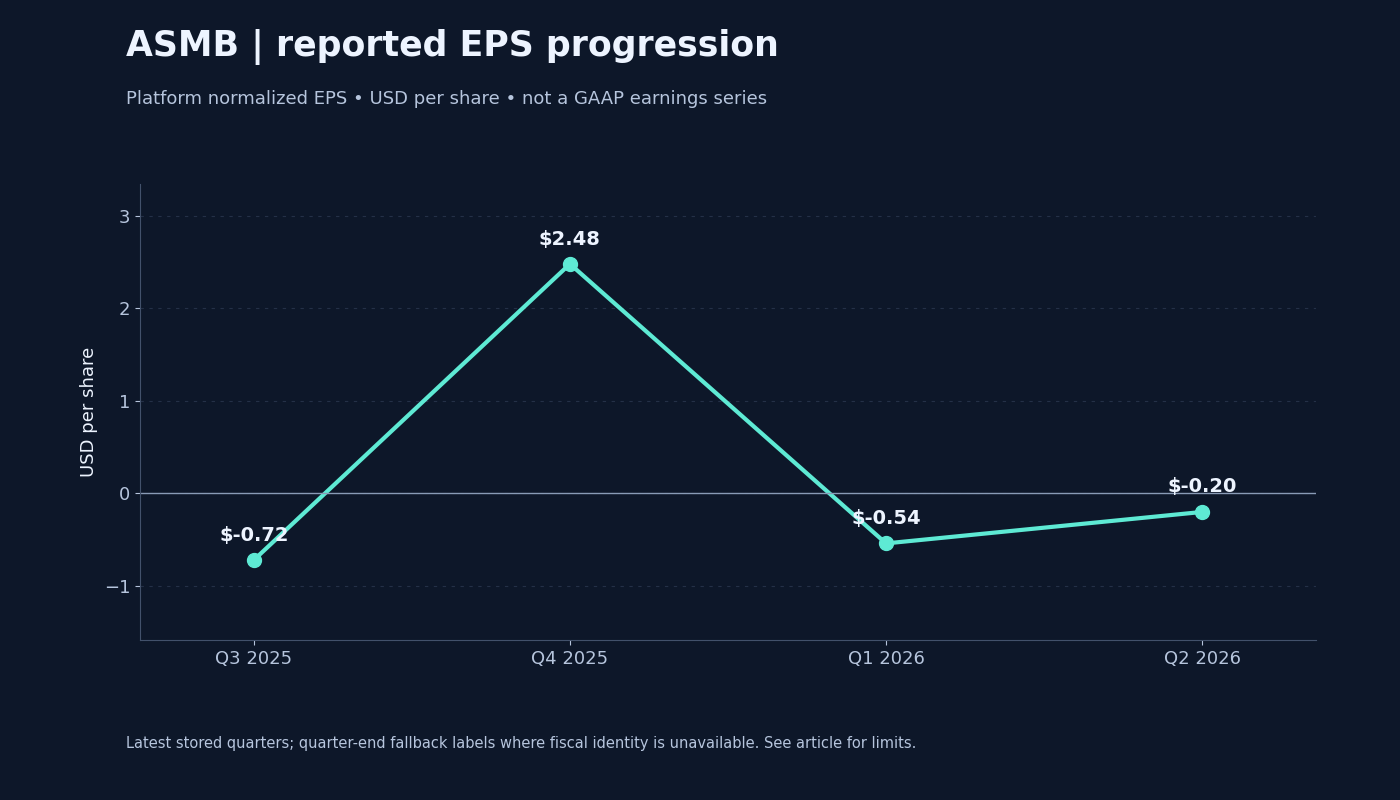
The issuer’s second-quarter results provide the necessary context. Collaboration revenue was $13.4 million, including a $5.1 million cumulative catch-up adjustment. Net loss was $3.9 million, or $0.20 per share; the company said a higher share count also helped reduce the per-share loss. Cash and securities totaled $320.4 million, and estimated runway into 2029 included an expected collaboration payment. Second-quarter financial results
Revenue recognized under a research arrangement is different from repeat medicine sales. A catch-up adjustment can improve one period without establishing the same run rate for future quarters. Similarly, a financing-supported cash balance reduces immediate funding pressure without eliminating eventual dilution or the cost of unsuccessful development.
Why the scores do not all agree
Price Score improved from 3.60 to 4.00 out of five, but Momentum fell to 44.63 out of 100. AI Score was 2.33 out of five. The Price Score favors aspects of a reversal setup, including price location and weekly behavior; it is not a profitability grade. The weaker Momentum reading warns that broader trend strength remains limited.
Tectonic and Tyra offer relevant clinical-stage portfolio comparisons, but they pursue different biological targets and indications. Their value here is to compare funding visibility, event timing and market behavior, not to imply that one company’s clinical result validates another’s drug. Correlated biotechnology trading can also make several seemingly different selections decline together.
What to watch after the conference
Constructive evidence would include a clear, funded development path and a share price that holds its recovery as trading activity remains firm. The inhibitors include disappointing clinical progress, an adverse safety signal, slower recruitment and financing needs beyond current plans. A conference appearance does not remove those risks.
For the next week, ASMB is a conditional recovery candidate rather than a confirmed momentum leader. Its increased activity and narrower latest EPS loss support monitoring, while the deep moving-average gap argues for demanding price confirmation. The larger clinical thesis will need patient data on a much longer schedule.