America’s AI expansion creates an investment story that extends well beyond accelerators. A computing campus also needs buildings, grid connections, cooling, networking and financing. Following those requirements helps investors understand where an announced budget might eventually become orders, revenue and cash flow.
Six project entries provide a useful map: Stargate, SpaceX’s proposed campuses, Hyperion, Colossus 2, Project Rainier, and Argonne’s Solstice and Equinox. They do not form a definitive ranking of closed financing. Their figures describe different assets, time periods and stages of development.
Key takeaways
- Program investment targets, campus development budgets and equipment leases are different measures.
- Private financing structures may separate ownership of infrastructure from the company using it.
- Supplier exposure is a research hypothesis unless a project-specific contract is verified.
Compare development budgets without adding unlike totals
OpenAI’s Stargate announcement described an intention to invest $500 billion over four years, starting with $100 billion. This is a program target, not cash already spent on one campus. Sponsor commitments still need to become financing, construction and usable computing capacity.
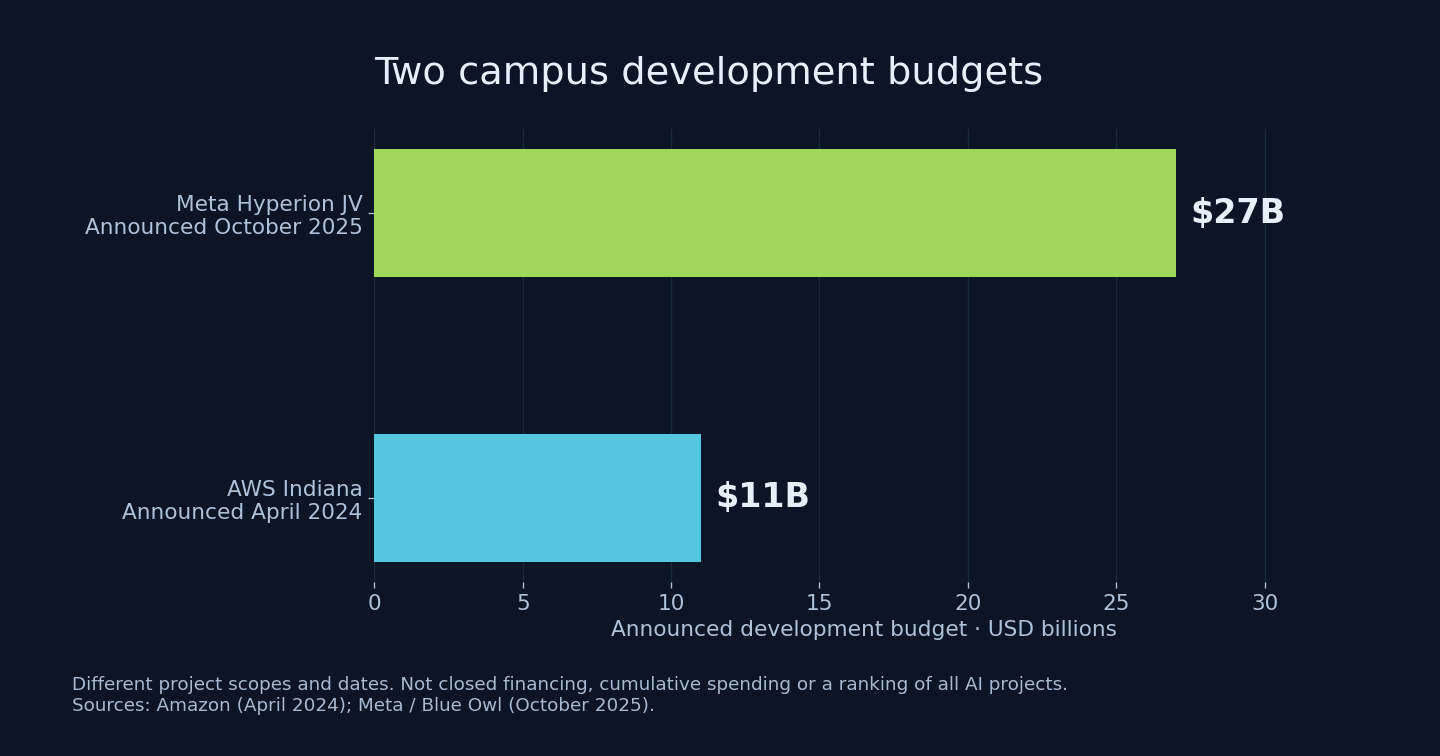
Meta’s Hyperion joint-venture announcement described roughly $27 billion in development costs, covering long-lived infrastructure. Blue Owl-managed funds hold 80% of the venture and Meta 20%. The structure illustrates how an operator can use infrastructure whose ownership and funding are shared with financial investors.
Amazon’s Indiana investment announcement described an estimated $11 billion development commitment. The chart compares announced development-budget categories only. It does not imply identical equipment scope, spending dates or financing status for Indiana and Hyperion, and the amounts are not summed with Stargate.
SpaceX and Colossus: separate proposals from equipment financing
SpaceX’s Cochise County project page describes a proposed $50 billion regional investment. Its Arizona permitting and grid work are separate milestones from operational capacity. The Texas campus proposal also requires project-level verification; a combined Arizona and Texas announcement should not be treated as closed financing.
For the Colossus 2-related computing expansion, Apollo’s January announcement described a $3.5 billion capital solution supporting a $5.4 billion acquisition and lease of compute infrastructure to an xAI subsidiary. The smaller number is part of the larger transaction, not additional funding to add again. It also is not the total cost of every campus.
Custom chips and scientific systems broaden the map
Amazon reported more than 500,000 Trainium2 chips powering Project Rainier. That illustrates a custom-silicon route alongside GPU-based systems. The chip count measures capacity, not the project’s financing value.
Argonne’s Solstice and Equinox announcement described 100,000 and 10,000 NVIDIA Blackwell GPUs, respectively. These scientific-computing systems bring a public-private research perspective. A comparable disclosed financing total was not established here.
Where the public-market opportunity could emerge
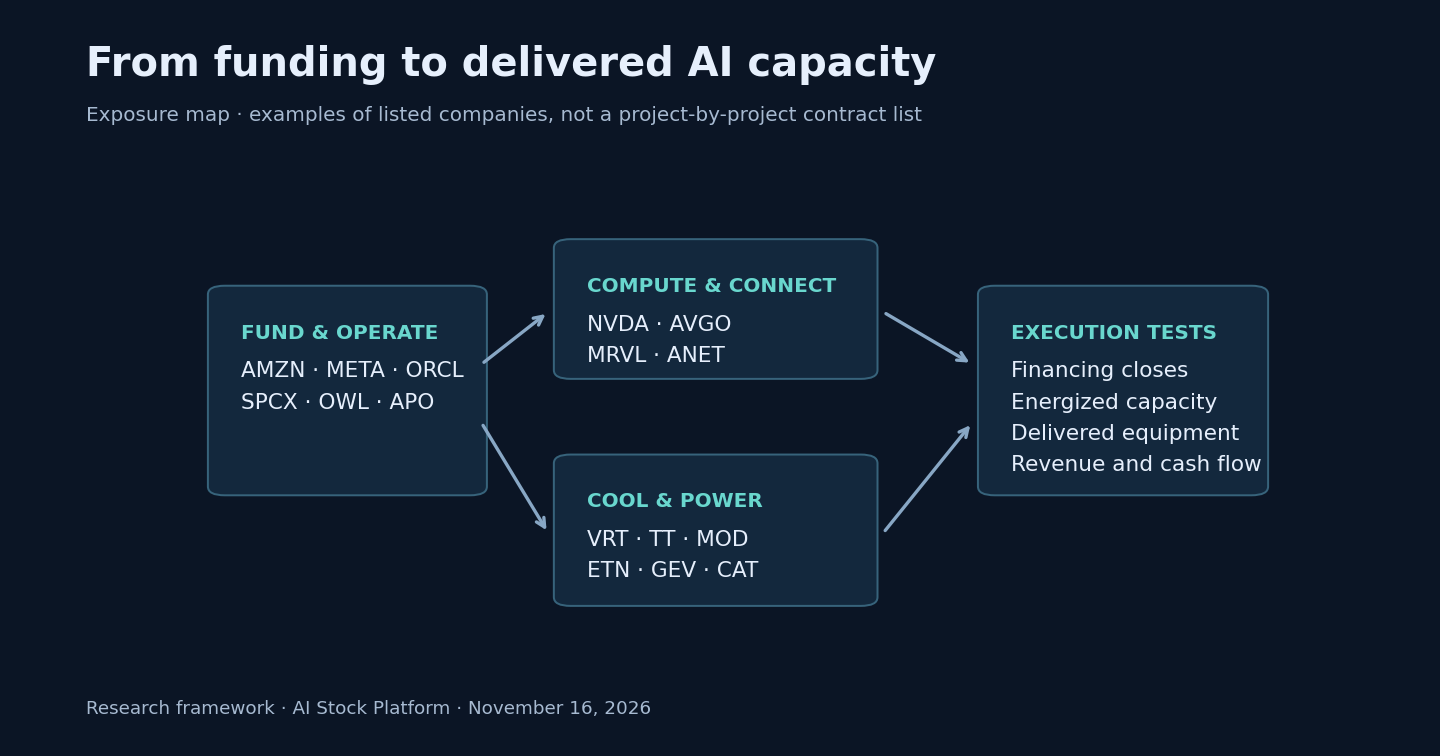
Nvidia, Broadcom, Marvell and Arista provide computing or networking exposure. Vertiv, Trane and Modine represent thermal-management research candidates; Eaton, GE Vernova and Caterpillar offer electrical or generation exposure. Oracle, Amazon, Meta and SpaceX provide operating or sponsor exposure, while Blue Owl and Apollo provide financing perspectives. Inclusion in this map does not establish a contract with every project.
At the November 13 close, Vertiv was $202.07, up 10.51% weekly, while Modine was $135.66, up 40.42%. Strong price action makes execution and valuation more important, not less. Financing closes, energized capacity and equipment deliveries are the milestones that can turn this broad construction theme into an evidence-based company investment case.