
Netcapital, Lion Group, AMTD IDEA and Cheche were selected for research because digital distribution, capital access and business restructuring offer identifiable growth opportunities. Their appeal comes from what an improving platform or better business mix might achieve, rather than from a low nominal share price. The four companies require different operating tests.
Three points frame the comparison. These are smaller, sometimes very small, businesses with uneven disclosure coverage. Their activities range from private-company finance to insurance technology and digital assets. Recent trading strength provides a starting signal, while reliable financial reporting and value created per share determine whether that signal develops into an investable business improvement.
Data as of 2026-11-10. Nasdaq quotes around 11:26 ET put NCPL at $1.8718, up 2.85%; LGHL at $1.705, down 5.28%; AMTD at $12.39, down 7.54%; and CCG at $11.595, up 21.16%. These are intraday prices, not completed daily returns. They illustrate the dispersion within the group during a tougher broad-market session.
Recent prices show different recovery paths
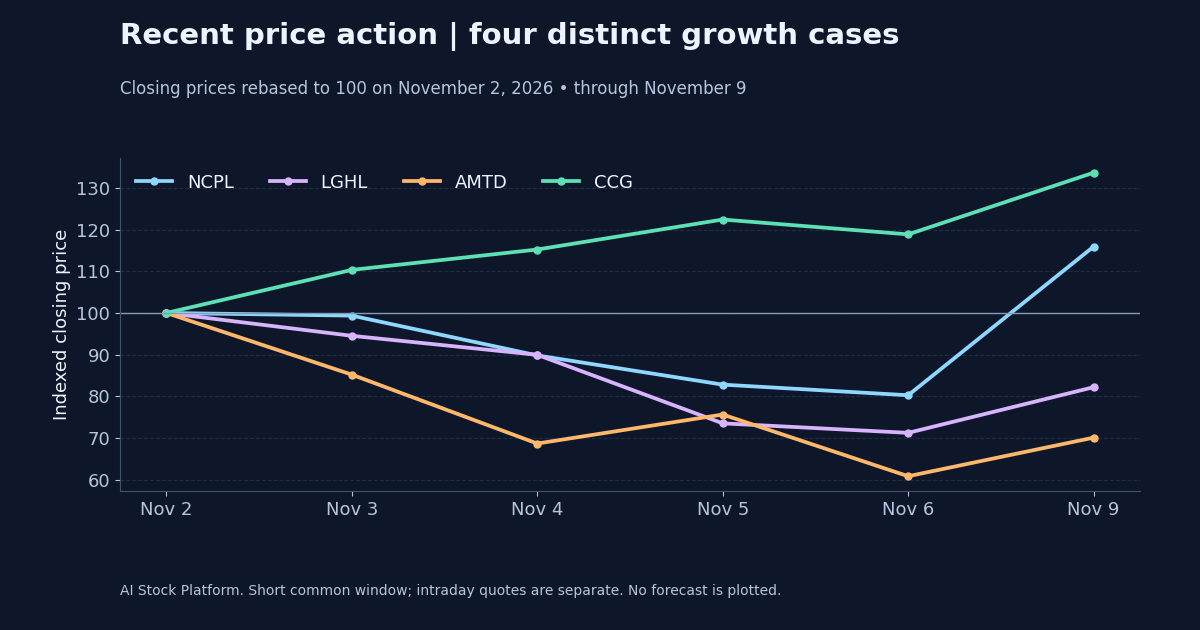
This short common window makes the recent paths easier to compare. Cheche and Netcapital finished above their November 2 starting points, while Lion and AMTD remained below theirs despite intervening rebounds. It avoids treating a one-day rally as evidence of a successful longer-term recovery.
Longer charts need extra care. ADS-ratio changes and share consolidations can make an old share price incomparable with today’s quotation unless the history is consistently adjusted. For that reason, this review does not rank the group by distance from an apparent yearly low. A small quoted price or extreme historical decline is not, by itself, evidence that the equity is undervalued.
Cheche’s latest platform Price Score was 4.04/5, alongside Momentum of 42.47/100 and AI Score of 2.32/5. The higher price-setup reading is not an equivalent earnings-quality rating. Price Score rewards some recovery characteristics, including lower annual-range positions, while Momentum and AI Score assess different signals. Corporate actions and incomplete financial coverage make it especially important to verify the underlying inputs before treating a score as evidence of an inexpensive business.
Netcapital: a capital-access platform with a reporting test
Netcapital’s investor materials describe a platform connecting private companies and investors. The growth opportunity is to broaden activity and improve the revenue generated from its financing ecosystem. Stronger transaction flow could make a relatively small operating business more economically significant, provided that growth reaches shareholders through sustainable results.
Timely disclosure is central to that assessment. A September SEC filing concerned Nasdaq notification of delayed annual and quarterly filings. The current quote feed also carried a compliance notification. The review found no verified basis to present that issue as resolved.
The constructive next step would be current accounts that establish the revenue trajectory, cash needs and share count. Until then, historical EPS observations are too old to establish current profitability. NCPL’s positive morning trading makes it worth monitoring, but improving reporting visibility would be a more substantial catalyst than the price movement alone.
Lion: digital-asset exposure can amplify both directions
Lion combines financial services with a digital-asset treasury strategy. Its September 30 announcement filed with the SEC described reallocating digital assets, including acquiring additional HYPE tokens. It reported holding 232,900 HYPE, valued around $20.1 million at that time. That was a dated asset valuation, not current cash or a measure of value available to common shareholders after liabilities.
The growth case depends partly on the success of the underlying services and partly on digital-asset outcomes. Those drivers can move differently from traditional lending businesses. Rising bond yields do not automatically improve this company’s economics in the way investors might expect from a straightforward banking comparison.
ADS changes and financing also complicate per-share comparisons. Fresh balance-sheet disclosure, clearer capital allocation and evidence of operating revenue would make the opportunity easier to evaluate. A stronger token market could help sentiment, while falling asset values or additional dilution could outweigh that support.
AMTD IDEA: look for operating value through a complex structure
AMTD IDEA offers exposure to a diversified group rather than a pure fintech application. Its investor information covers activities including financial services and other businesses. Research should distinguish the listed parent from affiliated companies and follow how transactions change the assets, liabilities and earnings attributable to that parent’s shareholders.
A November regulatory filing described a hotel-interest transfer involving affiliated businesses, completed November 2 with consideration involving newly issued shares. Such a transaction is relevant to the group’s structure; it should not be interpreted as an equivalent amount of new cash profit for AMTD IDEA.
The positive route is clearer recurring operating performance and more transparent per-share value. Current quarterly earnings coverage in the platform is insufficient for that conclusion today. That gap makes updated consolidated financial statements more useful than assigning a low valuation multiple from stale figures. Tuesday’s decline also shows why a prior rebound needs continuing business confirmation.
Cheche: better insurance economics offer a measurable opportunity
Cheche’s first-half results show a business shifting toward higher-margin insurance activity. New-energy-vehicle policies increased 29.5%, while gross margin rose from 4.9% to 6.5%. Revenue nevertheless fell 34.4%, and net loss widened to RMB44.1 million. Management also reduced its full-year revenue and NEV-premium guidance.
That combination supports a specific opportunity: an improved mix could strengthen economics if operating costs and revenue stabilize. It does not yet establish profitable growth. AI-enabled insurance tools offer another route to efficiency, but deployment must translate into measurable financial progress. The strong morning share advance makes subsequent execution particularly important.
Across the four selections, the most useful confirmation would be business growth that survives financing costs and dilution. Better disclosure, recurring revenue and improving cash conversion would strengthen the recovery case. These are research candidates selected for identified potential, rather than newly added portfolio positions or interchangeable small-cap financial peers.