
HawkEye 360 has fresh operating evidence behind its growth potential. The signals-intelligence company raised its annual outlook after stronger quarterly revenue, then announced a sizeable new group of contracts. Selected for this research series because of that identifiable expansion opportunity, HAWK now offers a clearer set of business milestones to assess alongside its share-price recovery.
Key takeaways
- Quarterly revenue growth supports the expansion thesis.
- New contracts broaden the opportunity across government customers.
- Satellite commissioning and cash conversion provide the next tests of delivery.
Turning radio signals into useful intelligence
HawkEye 360 detects and locates radio-frequency emissions using satellites and analytical software. Customers can use those signals to understand activity across places where visual imagery supplies only part of the picture. The business therefore competes on collection capability, coverage and the usefulness of its analysis to paying customers.
That model creates potential operating leverage. A broader satellite network can serve additional applications and customers, while software can turn collected data into repeatable services. Investors still need to distinguish physical capacity from monetized demand. A satellite in orbit contributes to the opportunity as reliable service, customer adoption and revenue recognition follow.
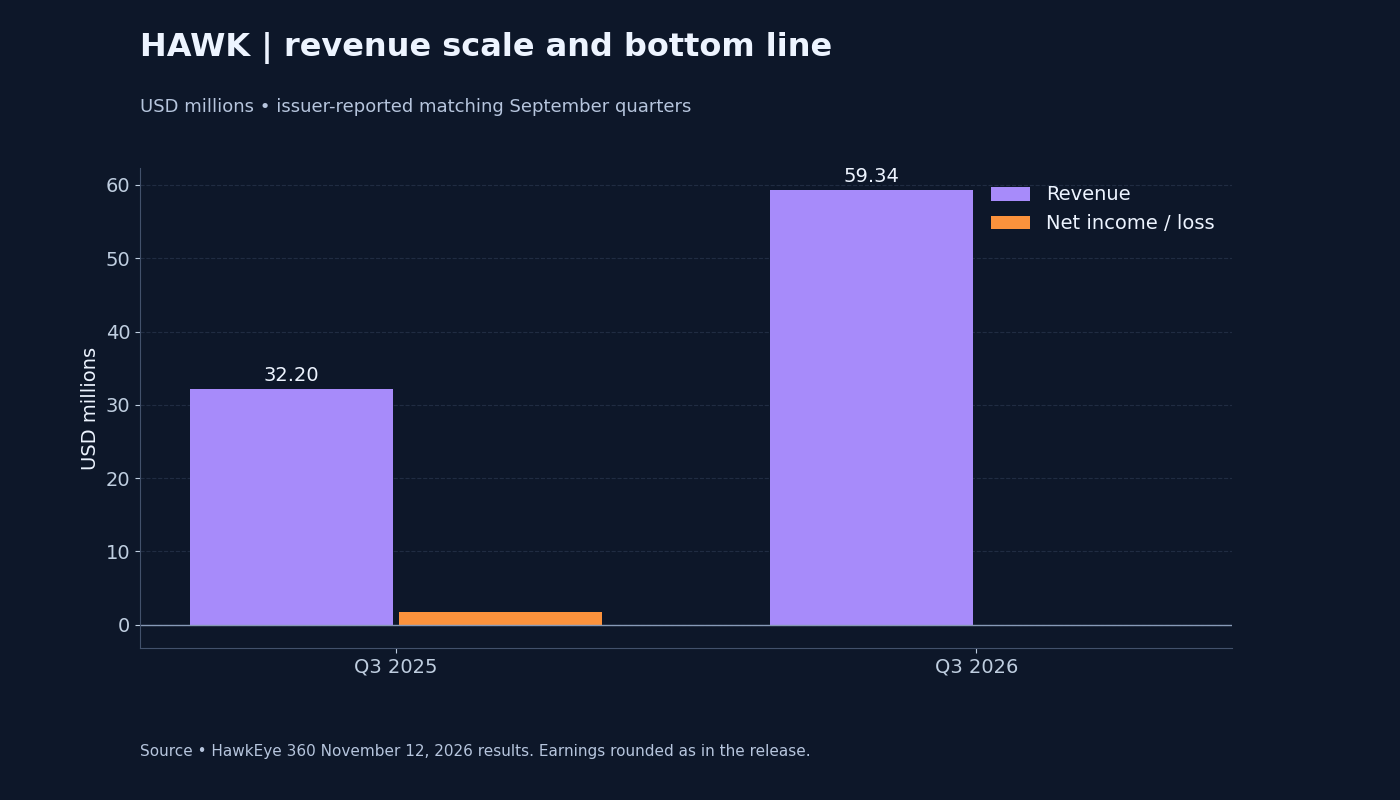
The November 12 release reported $59.3 million of third-quarter revenue, up 84% from the matching prior-year period. Adjusted EBITDA reached $13.3 million, while the company recorded a small net loss of approximately $0.2 million. Management increased its full-year revenue outlook to $225–$227 million and adjusted EBITDA outlook to $38–$40 million. HawkEye 360 results and guidance
A separate announcement described approximately $135 million of contracts signed since October 1, including more than $70 million in Europe. Those awards provide a concrete reason to investigate growth beyond the latest completed quarter. The timing also matters when comparing them with September-end backlog. Adding the two headline totals would require a reconciliation of timing, scope and recognition. New global contract awards
Revenue scale is improving faster than statutory profit
The comparison chart shows the matching September quarters, using issuer-reported revenue and rounded net earnings. It keeps the 84% sales increase visible alongside the much smaller bottom line. That combination is consistent with an expansion phase in which investment, operating costs and financing effects still influence shareholder earnings.
September-end backlog was $300.3 million. The release’s definition includes contractual features such as government ordering frameworks, so investors should monitor funded orders and conversion into recognized revenue. Management also reported $9.6 million of operating cash flow and approximately $0.1 million of free cash flow for the quarter. Backlog definition and cash generation
The commercial attraction is that additional contracts can spread the network’s costs over a larger revenue base. Improving utilization would support that outcome. Delivery delays, commissioning costs or uneven government procurement could reduce the benefit. Tracking revenue, cash generation and customer concentration together gives a more complete picture of the growth opportunity.
The latest price and the completed-session setup
The latest exchange quote was $17.685, +20.55%, at Nov 13, 2026 10:52 AM ET. This is an intraday reading from November 13. The compatible 52-week trading range was $11.25–$35.73, placing that quote 26.3% of the way from the low to the high.
The latest completed-session close, on November 12, was $14.67, with a -3.87% daily return and +14.97% five-session return. Its 50-session average was $14.62, with price +0.36% relative to that average. The chart uses those completed closes. Annual-range position measures where a price sits between its extremes, while the weekly return measures change over time.
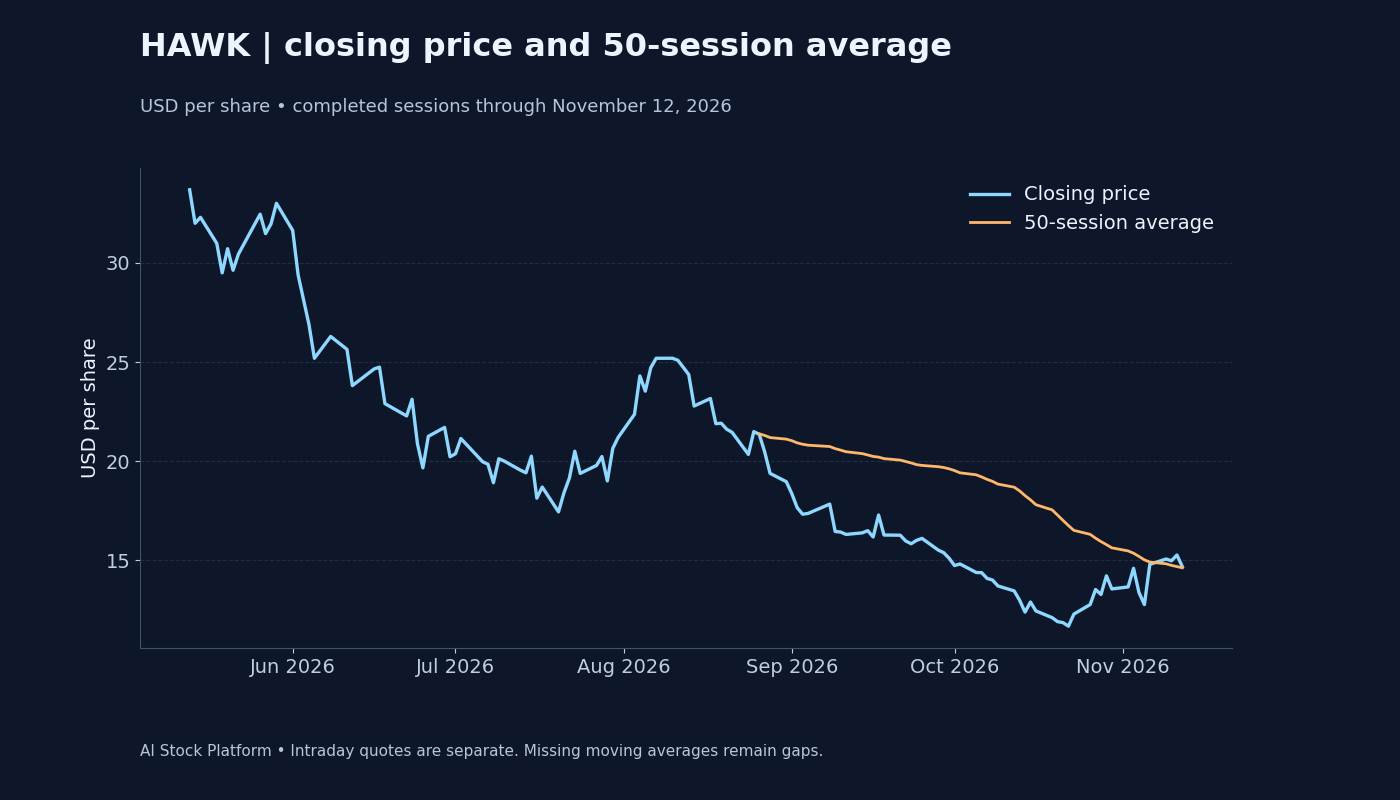
The prior close was almost level with its 50-session average. Friday’s upward move places the shares above that reference and gives the recovery a more constructive shape. The chart starts within the current issuer’s post-listing period, preserving gaps where the moving average lacks sufficient observations.
Reading the three research signals
The November 12 Price Score was 4.04/5, changing +0.28 points from November 11. Momentum V3 was 46.47/100, changing +1.73 points. The AI Score history for November 12 recorded 2.24/5.
Price Score currently combines weekly-return points, inverse distance from the 50-session average, industry sentiment, inverse annual-range position and rank movement. Its recovery-oriented design can favor a beaten-down share. Momentum describes price-feature strength, while AI Score adds a separate model view. Their different purposes explain why a constructive company catalyst can arrive alongside mixed historical signals. Friday’s live movement will enter subsequent completed-session measurements. Score methodology
A specialized position among space-data companies
BlackSky and Planet Labs offer useful listed comparisons for space-based data businesses. Their optical-imagery services differ from HawkEye’s radio-frequency specialization, so contract value and revenue multiples need business-specific interpretation. Comparing customer diversification, cash conversion and the pace of recurring revenue helps identify the stronger commercial model. BlackSky Planet Labs
Defense-related demand can help all three businesses, but their delivery economics vary. Investors should ask how much additional revenue each new customer brings, how long equipment remains productive and how much replacement spending the network requires. That connects the growth story to the returns available after maintaining the underlying assets.
Commissioning and contract conversion are the next catalysts
HawkEye reported the October launch of Clusters 15 and 16. Their commissioning offers a measurable operational milestone because usable capacity can improve the service customers receive. The next earnings release will be an opportunity to compare recognized revenue with the enlarged commercial pipeline. An exact next call date was unconfirmed at this research cutoff. Constellation update
The principal supporting factors are stronger sales and a wider contract base. The main risks are government budget timing, customer concentration, launch or commissioning disruptions and the cost of maintaining the network. A recent listing also provides a shorter public-market record than established defense suppliers.
The near-term assessment is constructive on business momentum. Sustaining that view requires the new capacity and awards to translate into revenue and shareholder earnings while cash generation improves. Those checkpoints give investors a practical way to follow the thesis after the initial results-driven advance.