
Las Vegas Sands offers an accessible recovery thesis built around established resort assets, tourism demand and shareholder distributions. Selected for this research series because of identified growth potential, LVS combines a price near the lower end of its annual range with an operating business that can benefit if resort profitability improves.
Key takeaways
- The shares remain in the lower part of their annual trading range.
- Resort earnings and capital returns provide measurable investment checkpoints.
- Improving margins across Macao and Singapore would strengthen the recovery case.
The opportunity sits inside operating resorts
Las Vegas Sands operates integrated resorts, combining gaming, accommodation, dining, shopping and convention activity. Its major markets include Macao and Singapore. That mix makes the company sensitive to visitor demand, spending per visitor, event activity and the cost of running large properties.
The appeal of a recovery setup is straightforward. Existing buildings and operating infrastructure can support additional activity, allowing incremental demand to contribute to profit. The extent of that benefit depends on room pricing, gaming mix, labor expense and promotional spending. Higher visitor activity is most valuable when the additional business carries healthy margins.
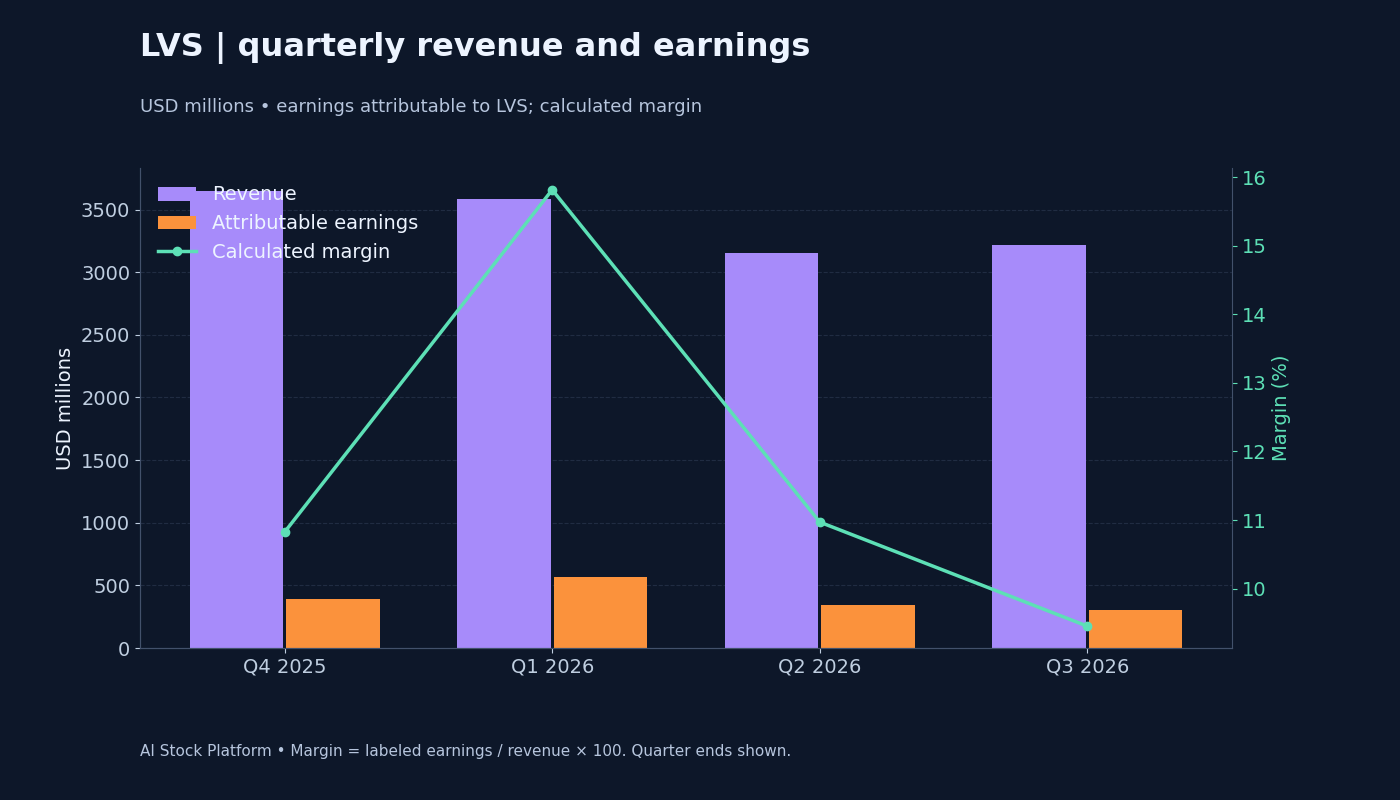
The latest published results cover the September quarter. Revenue was $3.216 billion, compared with $3.331 billion a year earlier. Adjusted property EBITDA was $1.119 billion, down from $1.344 billion. Those figures establish the operating hurdle a recovery needs to overcome. The stock’s current range position offers a starting point for research, while subsequent business improvement would provide the financial confirmation. September-quarter operating results
The geographic mix also matters. Singapore and Macao have different customer bases, capacity dynamics and regulatory settings. Following each market separately makes it easier to see whether improvement is becoming broad enough to support consolidated earnings.
Shareholder earnings and resort profitability tell complementary stories
Earnings attributable to Las Vegas Sands were approximately $304 million in the quarter. Dividing that amount by revenue gives an attributable-earnings margin near 9.5%. The chart consistently uses attributable earnings, keeping that definition separate from consolidated earnings that include noncontrolling interests. The company reported GAAP diluted EPS of $0.48 and adjusted EPS of $0.54. Earnings and accounting reconciliation
The four-quarter normalized EPS sequence is $0.85, $0.91, $0.59 and $0.54. It shows why improving resort earnings remains central to the thesis. A price rebound can arrive before reported earnings turn, but continued profit deterioration would make the recovery harder to sustain.
Capital returns offer an additional dimension. The release reported approximately $950 million of share repurchases and announced a 2027 annual dividend of $1.44 per share. Distributions can support shareholder returns, while their durability depends on cash generation and financing requirements. Capital returns
The investment opportunity therefore has two components. Investors can follow operating improvement at the resorts and assess how much cash can be returned after ongoing investment. A stronger combination of those factors would make the recovery more substantial.
The latest price and the completed-session setup
The latest exchange quote was $40.44, +2.82%, at Nov 13, 2026 10:52 AM ET. This is an intraday reading from November 13. The compatible 52-week trading range was $35.03–$70.45, placing that quote 15.3% of the way from the low to the high.
The latest completed-session close, on November 12, was $39.33, with a -2.24% daily return and -3.89% five-session return. Its 50-session average was $38.95, with price +0.98% relative to that average. The chart uses those completed closes. Annual-range position measures where a price sits between its extremes, while the weekly return measures change over time.
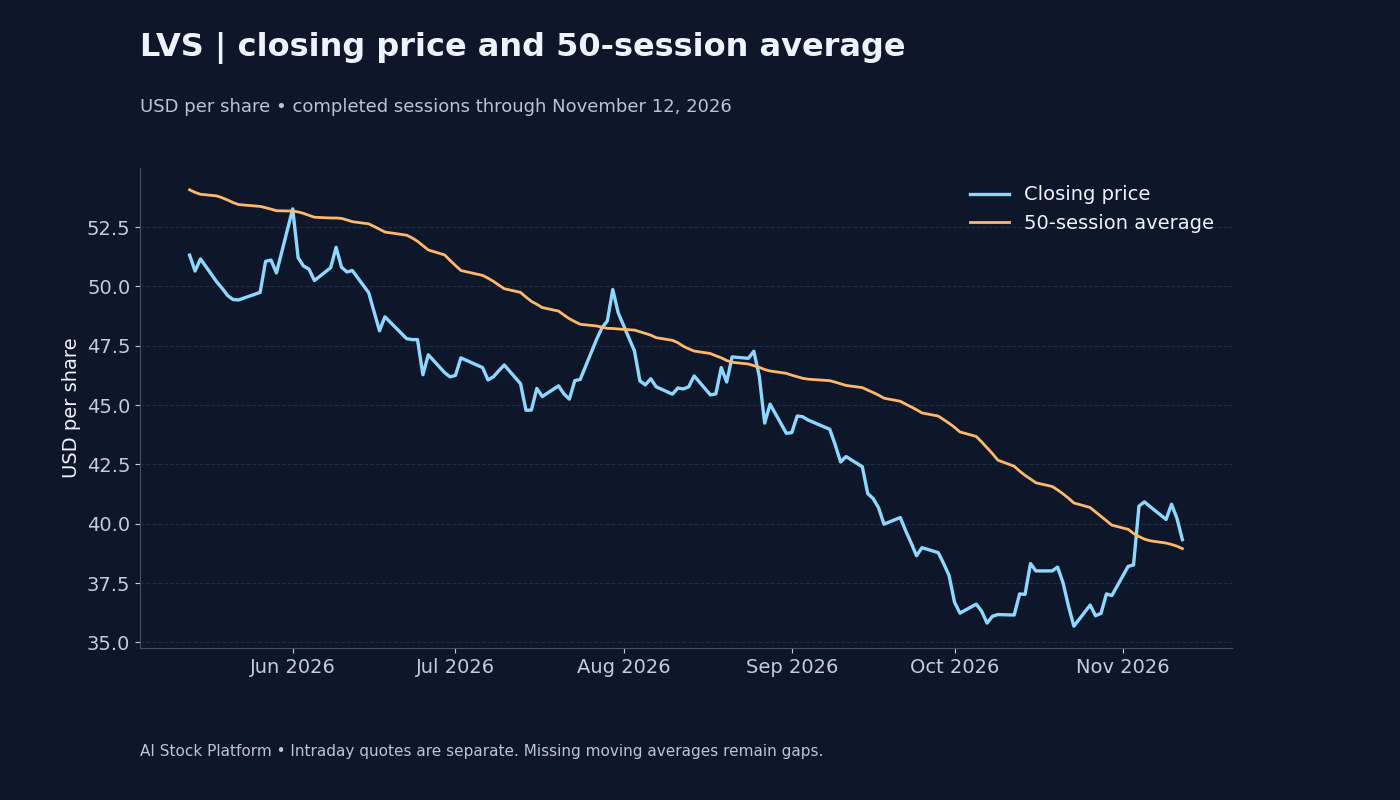
The low annual-range position makes LVS a recovery candidate with room to regain lost ground. Its modest distance above the moving average suggests an early stabilization phase at the completed-session cutoff. Friday’s additional gain improves the price picture, while consistent resort margin improvement would give it stronger operating support.
Reading the three research signals
The November 12 Price Score was 2.44/5, changing -0.04 points from November 11. Momentum V3 was 48.74/100, changing +1.13 points. The AI Score history for November 12 recorded 2.51/5.
Price Score currently combines weekly-return points, inverse distance from the 50-session average, industry sentiment, inverse annual-range position and rank movement. Its recovery-oriented design can favor a beaten-down share. Momentum describes price-feature strength, while AI Score adds a separate model view. Their different purposes explain why a constructive company catalyst can arrive alongside mixed historical signals. Friday’s live movement will enter subsequent completed-session measurements. Score methodology
A recovery comparison across resort operators
Wynn Resorts offers a useful comparison through its Asian resort exposure, while MGM provides a broader gaming and hospitality reference with a different geographic mix. Comparing segment profitability and cash requirements helps separate genuine recovery from a shared daily bounce. Their platform histories also show whether participation extends across related operators. Wynn Resorts MGM Resorts
An attractive comparison considers the profit generated by each resort after the spending required to remain competitive. A busy property may still require substantial reinvestment. Conversely, stable visitor activity with better pricing or lower operating costs can improve shareholder economics. That is why both demand and cash conversion belong in the assessment.
What would make the recovery more convincing
The next financial release should show whether demand is converting into higher property earnings and stronger cash generation. An exact next earnings-call date was unconfirmed in the evidence reviewed. Investors can follow the company’s announcements for a dated release and subsequent guidance. Las Vegas Sands investor news
Tourism spending, gaming regulation, competition and capital expenditure can all influence the outcome. Currency movements and the mix of customer spending add further variability. These factors deserve attention even when a share trades far below its annual high.
For the coming weeks, LVS has a constructive recovery setup with clear business checkpoints. Better margins, healthy resort demand and sustainable capital returns would strengthen the case. A rebound accompanied by weaker operating earnings would leave the thesis dependent on expectations. The most attractive progression would combine continued price stabilization with evidence that existing properties are generating more value for shareholders.