
Key takeaways
- Venture Global rose 5.50% at the November 11 close after its November 10 results; Ondas has a separately scheduled November 12 earnings call.
- Dutch Bros and Ondas sit near the lower end of their recorded yearly ranges, while Kohl's and Replimune are near the upper end. Heavy short interest does not make those setups equivalent.
- Short-float readings are dated position estimates, not a live count of investors buying back shares. Company results, price follow-through and volume provide the next evidence.
Summary comparison
| Ticker | Short % of Float | 50D MA Distance | Next Catalyst Date |
|---|---|---|---|
| VG | 90.11% | −6.10% | Not announced |
| UAA | 44.78% | +2.26% | Not announced |
| ONDS | 42.50% | −15.30% | Nov 12, 08:30 ET · call |
| KSS | 41.80% | +19.92% | Nov 24 · earnings |
| BROS | 41.14% | −13.89% | Not announced |
| CHTR | 40.08% | +13.86% | Not announced |
| BEAM | 39.28% | +1.68% | By end-2026 · expected filing |
| REPL | 36.13% | +50.09% | Not announced |
| RUN | 35.34% | +11.11% | Not announced |
| MMED | 34.39% | −8.02% | Nov 24 · earnings |
Short float uses the November 11 source readings below; moving-average distances use November 11 closes. Positive distance means above the 50-day average; negative means below. Catalyst dates reflect this article's November 12 pre-call outlook, including Ondas's scheduled call. Beam's filing window is an expectation, not a confirmed date; “Not announced” means no subsequent dated catalyst was verified.
Crowded bearish positions can create an opportunity when a company delivers better business progress than investors expect. This ten-stock group offers several routes to that outcome: liquefied natural gas production, autonomous systems, a consumer turnaround, expanding coffee shops and new medical treatments. The strongest research case combines a concrete catalyst with improving execution; a large short position merely makes the reaction potentially more sensitive.
The group comes from a November 11 Benzinga short-interest screen. Its reported percentages are historical leads, not a newly verified ranking of today's most shorted companies. Price comparisons below use AI Stock Platform's November 11 regular-session closes; company developments include announcements available on the morning of November 12.
What the bearish positions do—and do not—tell us
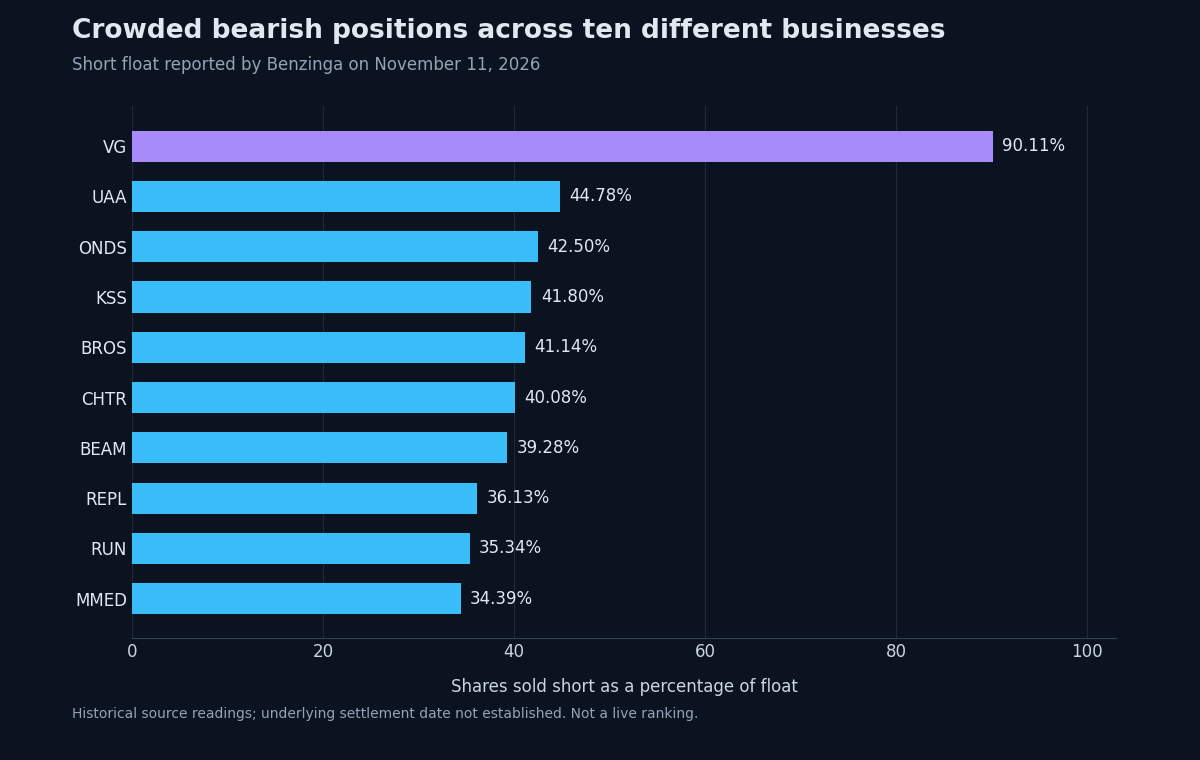
The first chart preserves one source's figures rather than combining incompatible rankings. Reported short interest measures shares outstanding on loan and sold short at a reporting date. FINRA's calendar places October 30 positions' publication on November 10. It therefore cannot show all position changes following November earnings releases.
Float matters just as much as the numerator. A restricted trading pool can make a percentage unusually high. Another dated short-interest table showed October 30 readings of 45.61% for Ondas and 37.31% for Under Armour, differing from the first chart. That disagreement is a reason to check share classes and denominator dates, not average the numbers. Under Armour's UAA class must also remain distinct from UA.
Borrow fees and comparable days-to-cover readings were not verified for all ten. They are not inferred from price gains. A rising stock can attract new buyers without shorts covering, and a large daily volume figure cannot identify which side initiated those trades.
Energy, autonomous systems and medical catalysts
Venture Global (VG): an operating catalyst behind the rebound. At $12.66, VG gained 5.50% on November 11 but remained 6.10% below its 50-day average. Its November 10 results reported $4.8 billion of quarterly revenue and $2.6 billion of adjusted EBITDA. Plaquemines Phase 1 began commercial operations on October 31. Sustained output and cash conversion would strengthen the recovery case; project execution and the distinction between adjusted and statutory profit still matter. The extreme short-float reading deserves particular scrutiny of the tradable share base.
Ondas (ONDS): growth expectations meet an earnings checkpoint. ONDS closed at $5.73, up 8.73% over five trading sessions, yet 15.30% below its 50-day average. It occupied only 12.8% of its recorded yearly price range. That creates recovery room, but does not establish cheap valuation. The company announced a November 12 call at 08:30 ET. Revenue delivery, integration costs and funding needs are the useful checks; no earnings beat or post-call rally is assumed here.
Beam Therapeutics (BEAM): clinical progress with a financing cushion. BEAM closed at $25.81, about 1.68% above its 50-day average. Its November 3 update identified a potential year-end 2026 risto-cel application and reported $1.0 billion of cash, equivalents and marketable securities. Management's mid-2029 runway expectation also includes a conditional additional financing draw. Clinical and regulatory progress could improve sentiment, but an expected filing is neither an approval nor evidence of commercial demand.
Replimune (REPL): commercial adoption is the next test. The October 28 corporate update described initial TUDRIQEV patient deliveries and prescribing institutions. That gives investors something more concrete to follow than a distant pipeline event. REPL nevertheless fell 6.44% to $21.78 on November 11 and stood 50.09% above its 50-day average. Its recovery has already traveled far. Adoption, reimbursement and cash use must support that stronger valuation backdrop.
MiniMed (MMED): a standalone business approaching results. MiniMed scheduled fiscal second-quarter results for November 24. The diabetes-technology company's $18.25 close was 8.02% below its 50-day average. Product uptake and standalone profitability are relevant to the investment case. Its shorter listed history and incomplete retained quarterly EPS sequence limit historical comparisons; an apparent earnings trend should not be manufactured from missing quarters.
Consumer and connectivity stocks offer different recovery paths
Under Armour (UAA): rebuilding demand, not just cutting costs. UAA closed at $5.01, down 13.17% over five sessions and in the lower quarter of its yearly range. The November 6 fiscal second-quarter release reported a 7% revenue decline to approximately $1.2 billion. A more durable rebound needs improving demand and margins together. Its low range position offers a starting point for research, while the sales decline explains why bearish investors remain involved.
Dutch Bros (BROS): business growth versus the price investors paid. Third-quarter results showed 29.8% revenue growth and positive same-shop sales. Yet BROS closed at $35.01, down 20.41% over five sessions and just 3.1% above the bottom of its recorded yearly range. That contrast makes unit economics, customer visits and expansion spending more useful than a squeeze narrative. Growing revenue does not guarantee that prior valuation expectations were reasonable.
Kohl's (KSS): much of the rebound is already visible. At $24.65, KSS was 19.92% above its 50-day average and near the top of its yearly range. Its investor calendar lists November 24 results. Holiday demand, inventory discipline and recurring profitability are the next research checks. The setup is different from a depressed-price recovery: earnings must justify an advance already achieved.
Charter Communications (CHTR): cash generation versus accounting losses. CHTR closed at $136.31, up 13.36% over five sessions. Its November 6 results included a large franchise impairment. Investors should separate that accounting charge from customer trends, capital spending and operating cash generation. Trading above the 50-day average supports a recovery interpretation, but does not by itself resolve competitive or balance-sheet questions.
Sunrun (RUN): storage growth needs cash discipline. RUN closed at $9.07, gaining 4.13% that day and standing 11.11% above its 50-day average. November 4 results reported a 75% storage attachment rate and revised cash-generation guidance. The opportunity is stronger storage demand alongside improving execution. Financing costs and the difference between operating cash flow and the company's defined Cash Generation measure remain central.
What could change the view
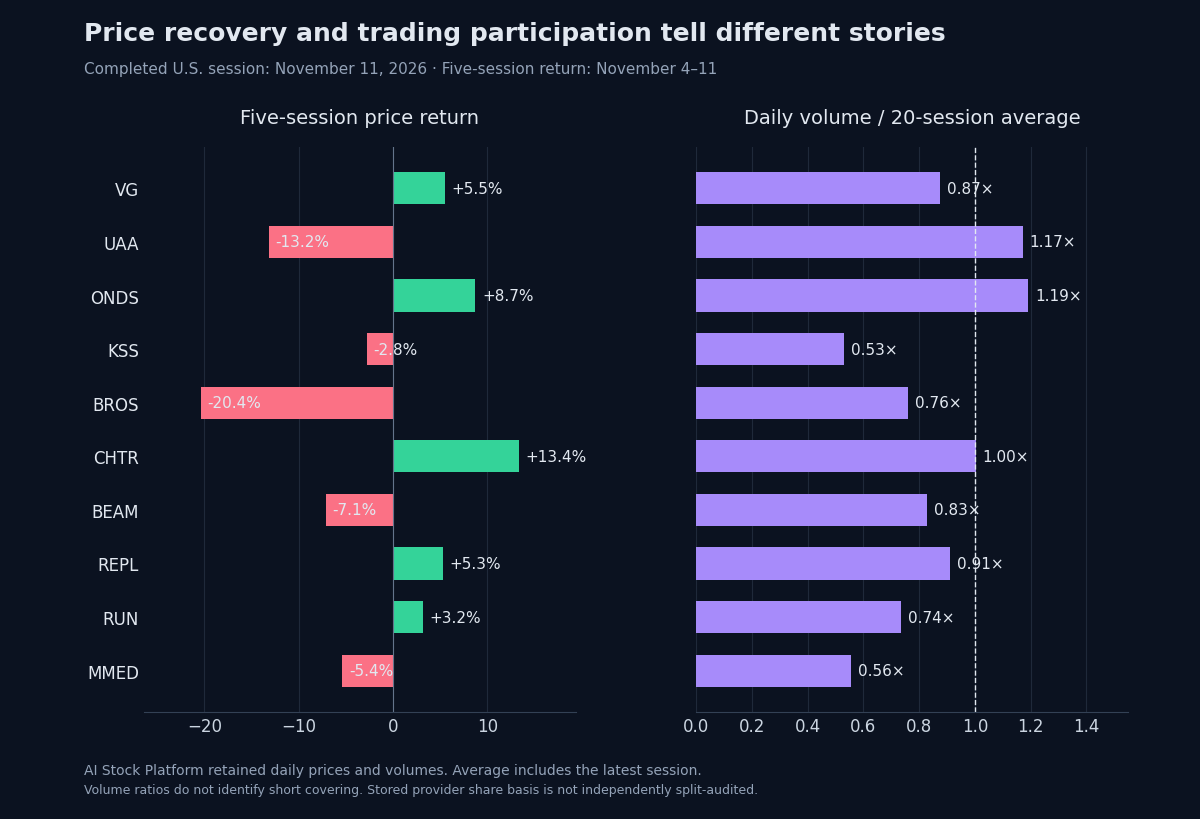
The second chart shows why rising prices should be assessed alongside participation. None of these November 11 volumes exceeded 1.2 times its 20-session average. That does not invalidate a rebound, but it does not establish exceptional buying pressure either. These volume ratios are context, not evidence of short covering.
A stronger case would combine delivered business progress, sustained price gains and firmer trading participation. Disappointing guidance, dilution or an unsuccessful clinical event could reverse that interpretation quickly. Fresh short-interest reports may also alter the crowding picture without changing the underlying business.
The most productive watch order is catalyst first, execution second and short positioning third. Ondas's earnings checkpoint and the November 24 reports provide dated tests; Venture Global, Dutch Bros and the medical names already offer operating developments to evaluate. High short interest makes these tests more consequential—it does not predetermine their outcome.