
Rayonier gives the Real-Money Portfolio a different kind of growth opportunity: productive timberland, opportunities to improve the asset mix and capital returns that can increase each remaining share’s claim on the business. Those drivers provide more than one route to progress as the combined company develops.
RYN is in the published Real-Money Portfolio, selected for identified growth potential under its monthly earnings-and-momentum rules. The November 8 roster sets an initial equal weight of about 8.33%, effective November 9. Earlier stock returns provide context for the selection and are not performance achieved by the new allocation.
Asset management and buybacks support the opportunity
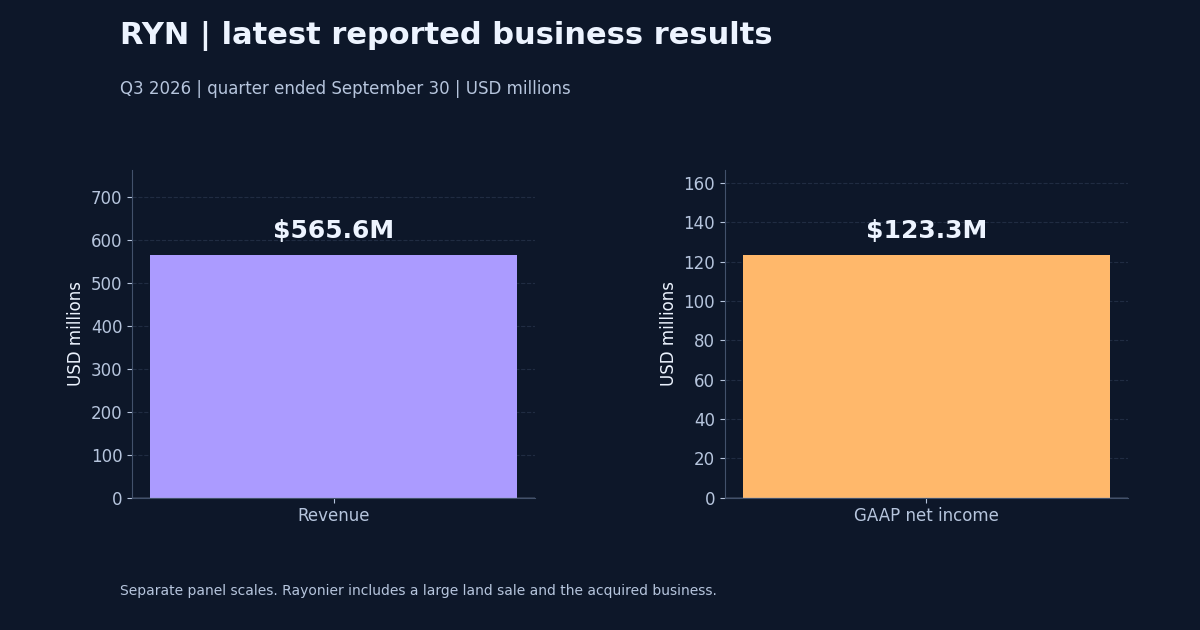
Rayonier reported November 4 that third-quarter sales were $565.6 million and GAAP net income was $123.3 million. Results included PotlatchDeltic operations and a large Washington timberland sale; they are not directly comparable with the smaller standalone business a year earlier. Excluding specified items, pro forma EPS was $0.13. The company completed paired timberland transactions, repurchased $59.8 million of shares at an average $21 and approved an additional $300 million repurchase authorization. Management expects softer fourth-quarter lumber realizations. The earnings call occurred November 5. Rayonier quarterly results and capital allocation update
The appealing feature is flexibility. Harvesting, managing timberland and realizing selected property value can contribute at different points in the cycle. A buyback can also improve per-share participation when carried out on attractive terms. An authorization creates capacity; it does not guarantee that the entire amount will be spent immediately.
The enlarged company should be evaluated on the productivity of its assets and the quality of cash generation. A major sale can unlock value without being a recurring source of quarterly income. Likewise, a larger acquired business changes both earnings capacity and the appropriate comparison base.
Looking through the large reported profit
The stored normalized EPS observations are $0.20, $0.07, $0.10 and $0.13. The latest sequential improvement fits the portfolio’s earnings assessment. The $0.13 aligns with the latest release’s pro forma measure, while GAAP diluted EPS was $0.41. These figures should remain distinctly labeled.
The results chart shows current revenue and GAAP net income, including the effects described above. It illustrates the reporting scale, rather than an organic growth rate. For the operating thesis, repeated delivery from timber and wood products is more informative than assuming a large asset-sale gain will recur.
What the latest price says about the opportunity
RYN closed November 9 at $21.82, up 1.25% for the session. Its rolling five-session return was +8.18%. The latest five-session average volume was 1.03 times the preceding, non-overlapping 20-session average. These are completed-session comparisons, not a forecast of the next week.
Nasdaq displayed $21.82 early on November 10 but no completed premarket volume or percentage change. The latest clearly completed-session reference remains the November 9 close; an unchanged display alone does not establish fresh buying. Nasdaq RYN quote
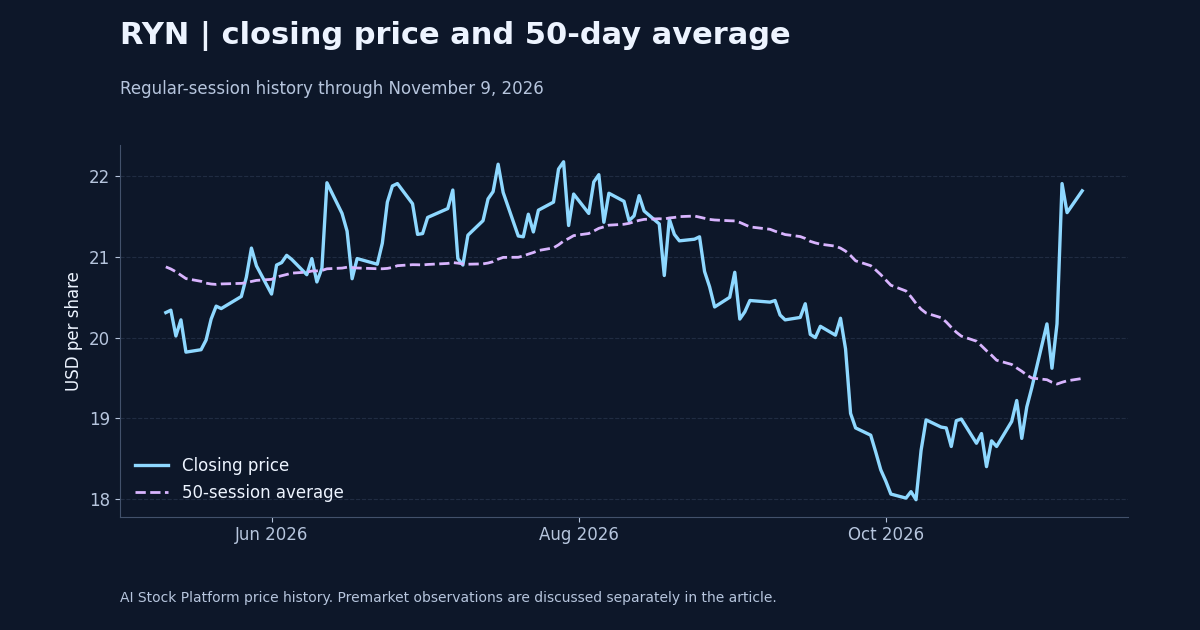
The close stood 11.94% above its own $19.49 50-session average. It occupied 57.5% of the platform’s annual closing range of $17.99–$24.65. This is a range of recorded closes; an exchange’s intraday 52-week extremes can differ. Trading above the average shows an established advance, while a large gap means that some near-term improvement may already be reflected in the price.
Reading the research signals together
The latest Price Score was 3.08/5, compared with 3.08/5 in the preceding session. Momentum was 48.23/100 and AI Score was 2.64/5. These are different research signals, not analyst price targets or probabilities of a positive return.
Price Score favors stronger weekly returns and rank improvement but also gives more points to lower annual-range positions and prices below the 50-day average. A stock can therefore advance strongly without receiving the highest Price Score. The portfolio’s earnings-and-momentum selection method is a separate calculation. Reading the signals together helps distinguish business progress, recent demand and the price already paid for that progress.
Multiple routes to improve per-share value
Rayonier’s opportunity comes from asset productivity, capital allocation and the integration of a larger operating base. Continued execution can make the investment case stronger without requiring a sudden housing boom. Lumber demand, pricing, integration costs and the timing of land transactions will influence the pace.
The constructive view is that management has several practical tools to improve shareholder value. The next useful evidence is recurring operating progress and disciplined use of capital, with one-off gains kept separate from the business’s underlying earnings power.