
Tuesday’s inflation report has raised the return investors demand from stocks. Treasury yields moved back toward 5%, while major equity proxies traded lower. That combination makes the quality and timing of future earnings more valuable: businesses that can fund growth and deliver improving cash generation have a clearer opportunity to distinguish themselves.
Three developments frame the session. October inflation exceeded the morning’s expectations, the 10-year Treasury yield approached a psychologically important threshold, and technology shares faced the sharper decline among the broad proxies checked. Together they favour selective research into durable growth rather than treating every falling price as the same opportunity.
Data as of 2026-11-10. Equity observations below are intraday, around 11:26–11:31 ET; they are separate from the platform’s completed November 9 closing-price history. The yield observations are from earlier Tuesday reporting, not a synchronized live bond quote.
Inflation changes the hurdle for equities
The Bureau of Labor Statistics’ October release showed consumer prices rising 0.4% from September, seasonally adjusted. Core prices, excluding food and energy, increased 0.3%. Headline inflation slowed from September’s 0.6% monthly increase, but the core reading remained firm. The release does not provide a conventional October year-over-year comparison because the corresponding October 2025 observations were unavailable during the federal funding lapse.
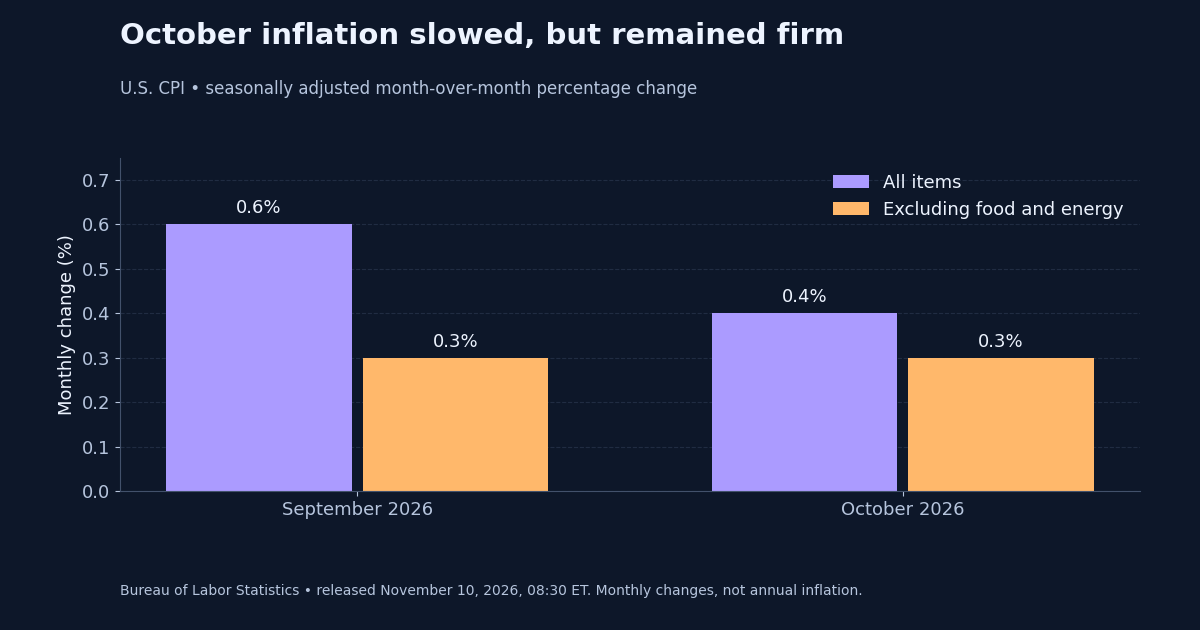
Schwab’s opening commentary reported expectations of 0.3% headline and 0.2% core inflation, putting both actual readings above that forecast. It placed the 10-year yield near 4.94%, around seven basis points higher. A separate Tuesday bond-market update described the yield near 4.95%. These observations support “toward 5%”; they do not establish that the yield has crossed 5%.
The distinction matters. Inflation can slow compared with the previous month while still disappointing investors who expected a faster improvement. Prices react to that gap between expectations and outcomes, alongside changing views about monetary policy and the compensation required to hold longer-term debt.
Why higher yields can pull stocks lower
A share represents a claim on future business cash flows. When the return available from government bonds rises, those future cash flows are generally worth less today under an otherwise unchanged valuation. The effect can be particularly pronounced when much of a company’s expected value depends on profits several years away.
There is also a practical financing channel. Companies refinancing debt or funding new facilities may face a higher cost of capital. Projects that looked attractive at a lower funding rate can offer a narrower margin of safety. Firms with cash on hand, manageable maturities and self-funded expansion have more flexibility to keep investing through that adjustment.
Five percent itself is not a mechanical sell signal. A growing company can offset a tougher discount rate by exceeding earnings expectations. Equally, a low share price cannot offset weak economics indefinitely. The useful question is whether operating progress is strong enough to improve per-share value after allowing for financing costs and possible dilution.
The morning decline is broad, with technology under greater pressure
Nasdaq’s intraday quotes around 11:29 ET put SPY at $747.59, down 0.68%; QQQ at $673.24, down 0.90%; and DIA at $520.21, down 0.60%. These funds provide proxies for the S&P 500, Nasdaq-100 and Dow respectively. Their changes are ETF price returns, not official index closing results. The Nasdaq SPY quote page provides the relevant market context.
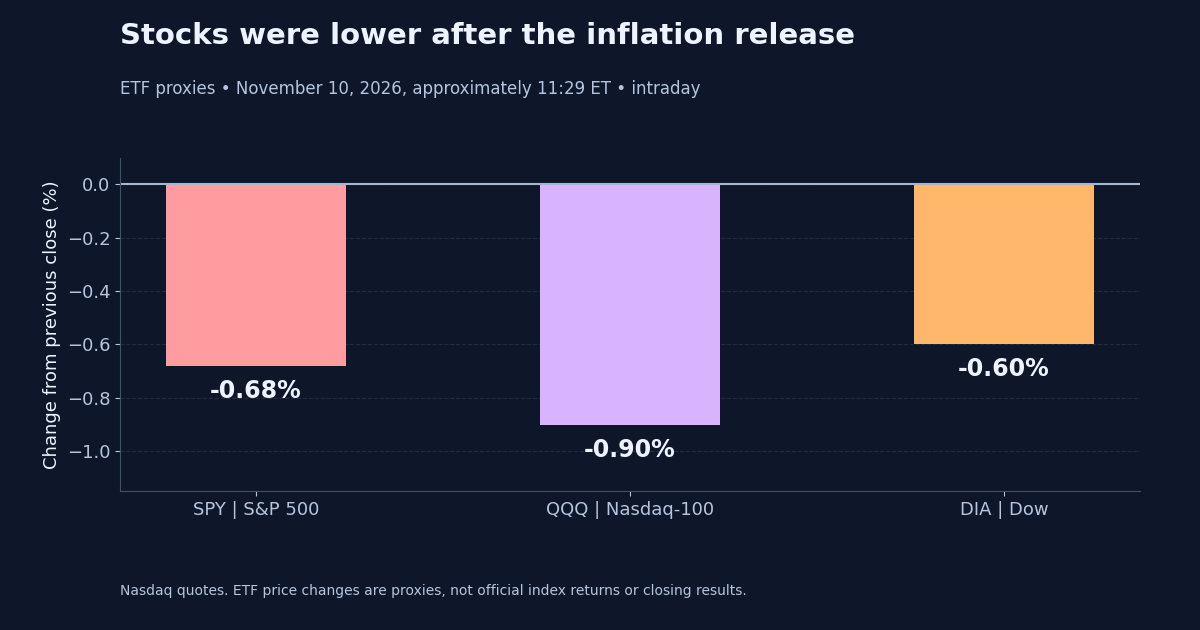
The larger technology-proxy decline fits the valuation sensitivity described above, but one morning does not prove that rates explain every individual move. Earnings announcements, positioning and company news can reinforce or offset the macro effect. A strong company holding up better than its peers can become a useful research lead, particularly when buying persists beyond the initial reaction.
Where portfolio research becomes more useful
The published Real-Money Portfolio includes National Health Investors, Rayonier and MGE Energy. Their real-estate, timberland and utility exposures make funding costs relevant, but their businesses have different operating drivers. Rent collection, timber demand and regulated investment economics should each be assessed on their own terms.
Around 11:31 ET, NHI traded at $66.71, RYN at $21.50 and MGEE at $79.902. Those prices are observations, not evidence that the inflation release alone caused their moves. Their inclusion illustrates why portfolio exposure should be examined alongside company-specific results before changing a growth assessment.
A constructive selection framework for the next session
The strongest candidates will combine an identifiable operating catalyst with enough financial capacity to reach it. Improving revenue quality, narrowing losses and progress toward positive cash generation can strengthen the growth case. Holding recent price support on normal trading volume would add market confirmation, although a technical signal cannot substitute for funding visibility.
Conversely, debt coming due, repeated equity issuance or a valuation built on distant earnings can weaken the opportunity when yields rise. The next useful check is whether Treasury yields stabilize while company earnings expectations hold up. That combination would give well-funded growth businesses a firmer foundation for recovery; persistent yield increases accompanied by weaker operating outlooks would require a more selective entry assessment.