
Tandem Diabetes Care has a fresh product catalyst alongside improving operating results. A new Mobi clearance expands its future commercial opportunity, while the latest quarter shows a smaller loss and higher sales. Selected for this research series because of identified growth potential, TNDM offers a recovery case grounded in product execution and more efficient growth.
Key takeaways
- The latest clearance expands the Mobi product opportunity.
- Quarterly sales growth and a smaller operating loss show measurable progress.
- Commercial launch timing and product reliability remain central to execution.
A product update with a defined launch window
Tandem develops insulin-delivery systems that combine pumps, software and related consumables. Its economics depend on attracting users, retaining them and supplying ongoing equipment and consumable needs. That makes product convenience, reimbursement access and service quality important to commercial growth.
On November 13, Tandem announced FDA clearance for a tubeless Mobi infusion set with wear of up to seven days. The associated cartridge has a three-day use clearance. The company expects a commercial launch in the first half of 2027. These separate specifications help investors understand the planned product and its different replacement intervals. Mobi clearance and planned launch
The growth opportunity comes from converting product improvements into adoption and repeat purchasing. Compatibility with existing customers can help the upgrade path, while expanded distribution may improve access. Revenue still depends on launch readiness, payer coverage, supply availability and customer decisions after the clearance milestone.
For investors, this creates a sequence of observable events. A cleared product can progress toward launch, then initial use, repeat demand and financial contribution. Each stage supplies stronger evidence about commercial value. Friday’s share-price response captures expectations about that process, while the operating results provide a separate measure of the existing business.
The loss is narrowing as sales expand
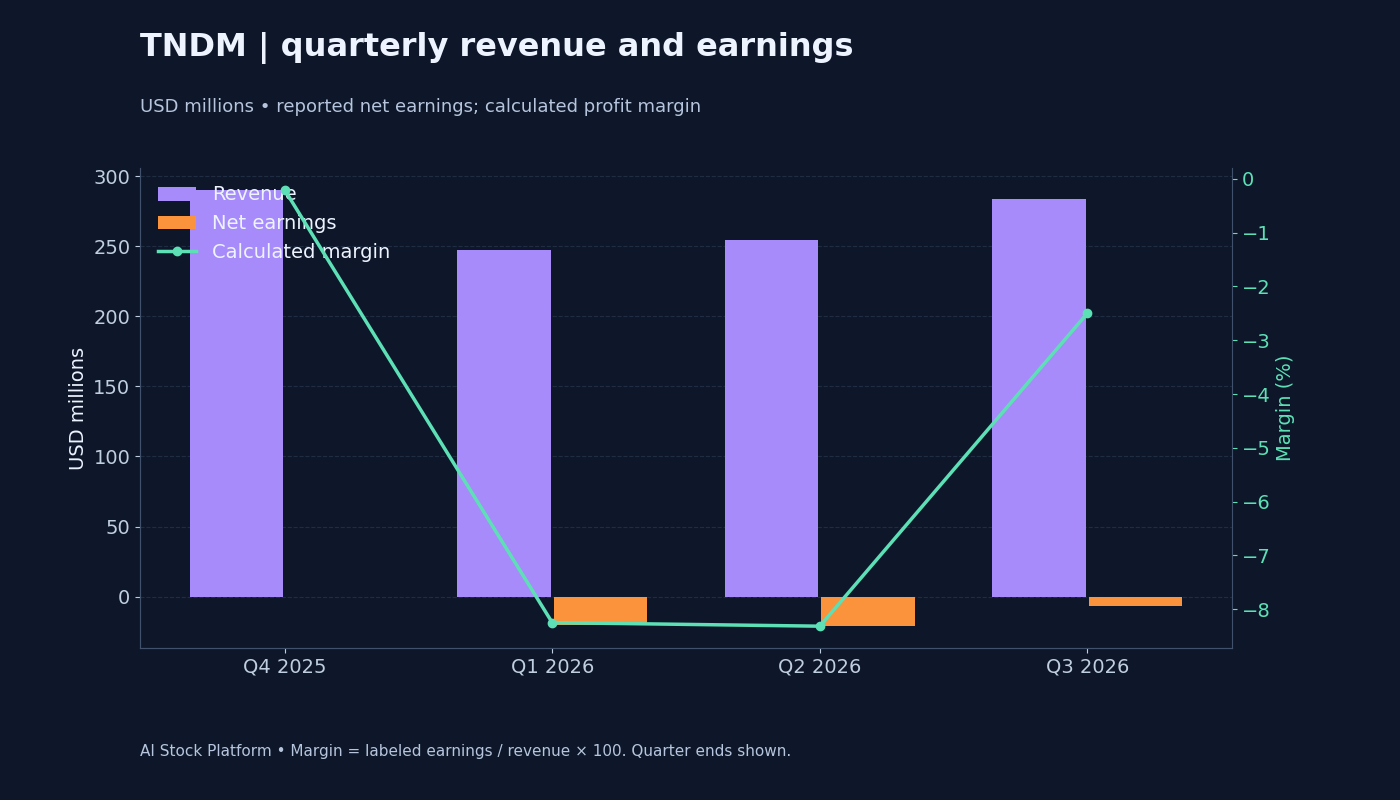
Third-quarter worldwide sales reached $283.7 million, up 14% year over year. Gross margin improved to 57%, and the operating loss narrowed to approximately $2.4 million. GAAP diluted EPS was negative $0.10, compared with negative $0.31 a year earlier. Management maintained full-year sales guidance of $1.065–$1.085 billion. Tandem third-quarter results
The chart shows the recent quarterly revenue and net-earnings sequence. September-quarter net loss of approximately $7.1 million gives a calculated net margin near negative 2.5%. The improvement from the June quarter is encouraging because it connects sales scale with a smaller loss. Seasonal purchasing patterns and launch costs can still influence individual quarters.
The retained normalized EPS sequence is negative $0.01, negative $0.30, negative $0.31 and negative $0.10. The latest observation matches the newly reported loss per share, while earlier normalized observations retain their own accounting label. A durable recovery would show sales expansion, better gross profit and controlled expenses continuing together.
The latest price and the completed-session setup
The latest exchange quote was $19.55, +11.65%, at Nov 13, 2026 10:52 AM ET. This is an intraday reading from November 13. The compatible 52-week trading range was $12.26–$29.65, placing that quote 41.9% of the way from the low to the high.
The latest completed-session close, on November 12, was $17.51, with a -6.71% daily return and -2.67% five-session return. Its 50-session average was $17.41, with price +0.59% relative to that average. The chart uses those completed closes. Annual-range position measures where a price sits between its extremes, while the weekly return measures change over time.
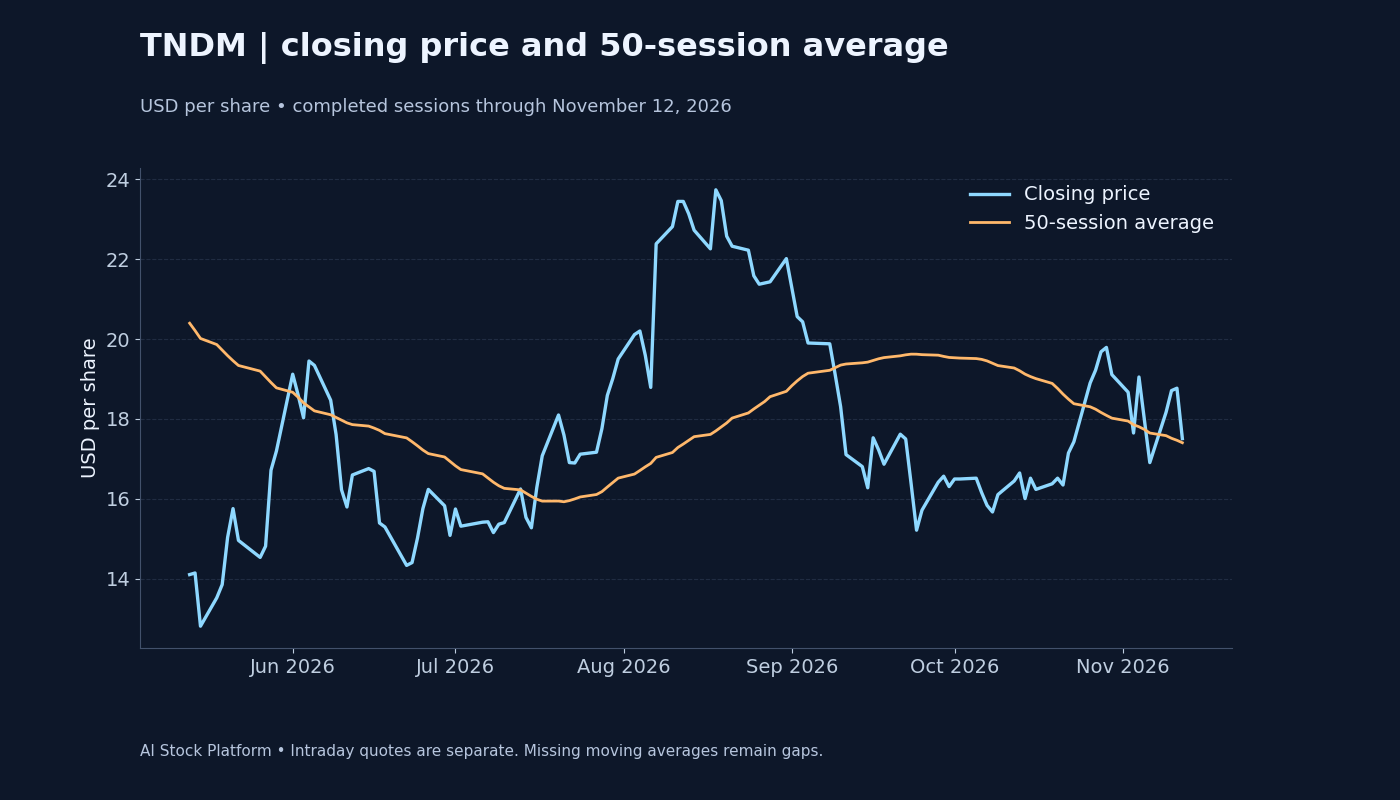
Friday’s recovery follows a completed session that finished close to the moving average. The price is still well inside its annual range, leaving room to rebuild earlier lost ground. Continued buying would become more persuasive as the commercial milestones approach and operating delivery supports expectations.
Reading the three research signals
The November 12 Price Score was 2.76/5, changing -0.04 points from November 11. Momentum V3 was 50.59/100, changing +1.78 points. The AI Score history for November 12 recorded 2.37/5.
Price Score currently combines weekly-return points, inverse distance from the 50-session average, industry sentiment, inverse annual-range position and rank movement. Its recovery-oriented design can favor a beaten-down share. Momentum describes price-feature strength, while AI Score adds a separate model view. Their different purposes explain why a constructive company catalyst can arrive alongside mixed historical signals. Friday’s live movement will enter subsequent completed-session measurements. Score methodology
Comparing product adoption across diabetes technology
Insulet supplies a relevant comparison in automated insulin delivery, particularly around product adoption and recurring consumables. DexCom is a useful adjacent comparison in continuous glucose monitoring, which plays a different role in diabetes technology. Investors can compare earnings direction and price behavior while preserving those business differences. Insulet DexCom
For Tandem, a competitive product needs both appealing functionality and dependable support. Growth in the installed user base can create repeat revenue, but acquisition costs and service requirements affect profitability. The strongest commercial outcome would combine durable customer retention with a more efficient route to each additional sale.
Product reliability and launch execution deserve equal attention
Recent FDA records include a Class I Mobi correction concerning false occlusion alarms and a Class II correction involving Android software. Those notices are material to service costs, customer confidence and execution. A balanced growth assessment incorporates product-quality follow-through alongside new clearances. FDA Mobi correction FDA software correction
Management is scheduled to present at the Jefferies Global Healthcare Conference on November 19 at 3 a.m. Eastern Time, followed by Piper Sandler on December 3 at 9 a.m. Eastern Time. These are confirmed presentations where investors can look for distribution and launch commentary. Confirmed conference schedule
The near-term case is constructive on product opportunity and improving operating efficiency. Competition, reimbursement constraints, financing obligations and launch spending remain inhibitors. Stronger adoption with sustained loss reduction would provide the clearest evidence that the opportunity is becoming a more durable growth business.