
Three things to know
- Tyra Biosciences is in the Bull Portfolio for short-term growth, after a 0.38% completed-week advance.
- Monday’s available premarket quote was $21.30, up 0.71% from Friday’s $21.15 close, at 4:46 a.m. ET on November 9.
- The latest stored quarterly loss per share widened slightly; TYRA qualified under the relaxed EPS rule, not because earnings accelerated.
Tyra Biosciences gives investors exposure to a targeted oncology development story with encouraging early clinical evidence to follow. Its share price remains in the lower part of its annual closing range, creating a focused opportunity to examine how clinical progress and investor engagement could contribute to a recovery.
TYRA is included in the public Bull Portfolio because the November 6 screen identified short-term growth potential across price location, a positive completed week and the portfolio’s EPS and trading-participation eligibility rules. The selection brings attention to an emerging setup alongside the company’s clinical program; the sections below explain the earnings, volume and development evidence in detail.
Clinical interest has a specific source
Tyra develops precision medicines targeting fibroblast growth factor receptor biology. The relevant investor question is whether a promising biological approach produces convincing, durable results in the patients for whom it is intended. Early responses can create interest before the evidence is sufficient for approval or commercial use.
Its September 9 SURF302 update reported a 79% three-month overall response rate in 14 efficacy-evaluable patients receiving the 60 mg dose of dabogratinib, with complete responses in eight of those patients. This was an initial Phase 2 result in low-grade intermediate-risk non-muscle-invasive bladder cancer, not an approval or a cure rate established in a large population. Small cohorts and response durability remain important limitations. Initial SURF302 results
That result helps explain the company’s research relevance, but it is not news newly released this morning. A short-term article needs to avoid recycling an older clinical announcement as a fresh catalyst. Subsequent evidence should be judged on follow-up, safety and development decisions rather than the most striking percentage from a small subgroup.
This week’s event is investor access
The company has confirmed one-on-one meetings at the Guggenheim Healthcare Innovation Conference on November 10. It also lists a Jefferies presentation for November 16 at 11:30 a.m. GMT. The first event falls within this week; the second is next week. Neither notice promises a new trial readout. Company conference announcement
Investor meetings may clarify priorities and encourage closer attention, but their market effect is uncertain. If no material new information is disclosed, the stock can continue to move with biotechnology risk appetite and its own trading flows. An estimated earnings date circulating elsewhere should not be elevated to a confirmed issuer event without confirmation.
The price setup has room, but limited force
Friday’s close stood 27.1% of the way through the platform’s annual closing range of $14.28–$39.61. It met the screen’s below-30% condition, but was closer to that threshold than several other Bull selections. A low position is a description of price history, not a guarantee that old highs are recoverable.
The completed five-session return was 0.38%, and the one-month gain was 5.91%. The $21.15 close remained 4.62% below the $22.17 50-session average. That is a smaller gap than those of TECX or ASMB, but the small weekly gain also means the current case lacks a forceful upward push.
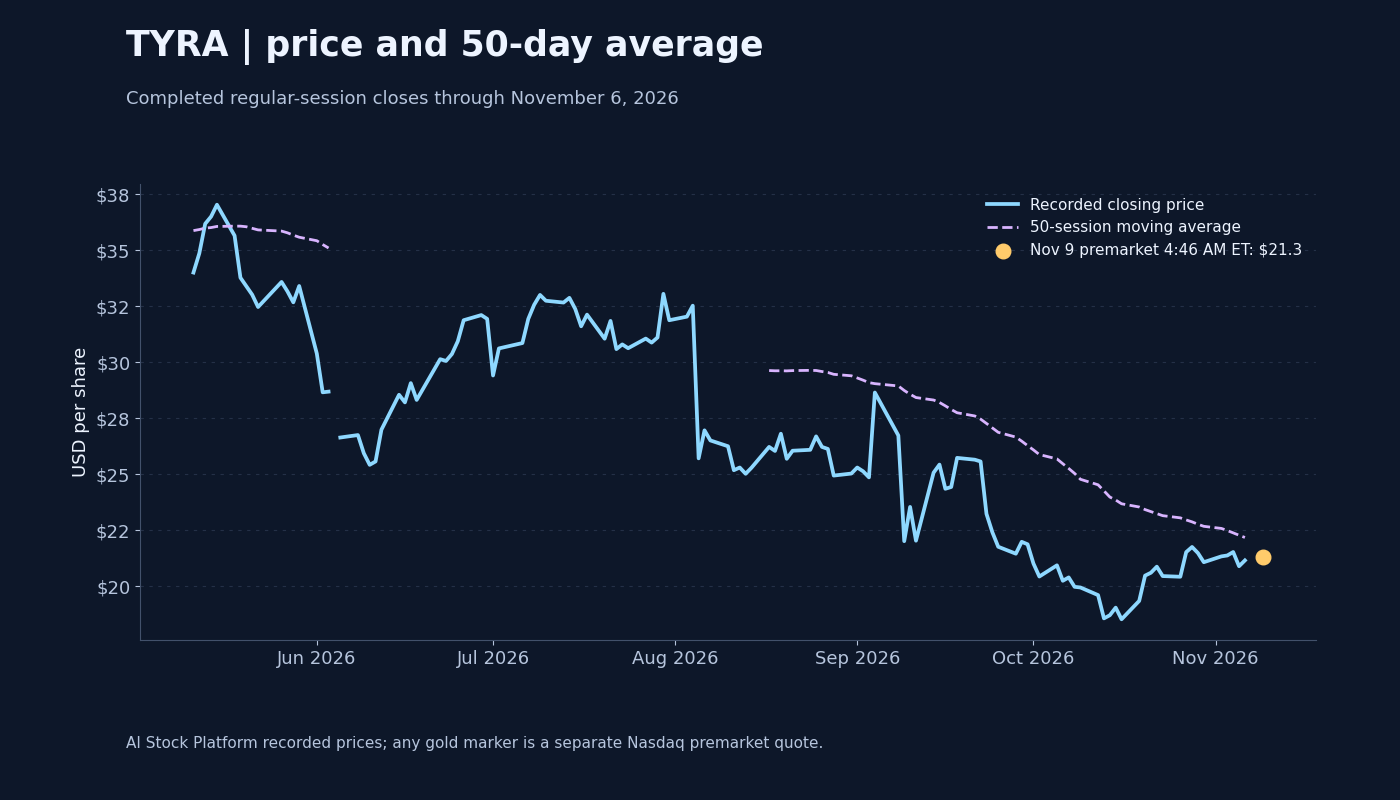
Average volume over the latest five sessions was only 1.004 times the preceding, non-overlapping 20-session average. It technically met the relaxed volume condition, but activity was essentially unchanged. Describing that as strong buying confirmation would overstate the evidence. The next useful signal would be improved participation accompanying sustained price progress.
EPS is a qualification, not the investment thesis
The stored normalized EPS sequence was negative $0.50, negative $0.57, negative $0.64 and negative $0.69. The latest loss widened. The portfolio’s symmetric EPS comparison was approximately negative 3.76%, within the relaxed negative-5% tolerance. This explains eligibility without calling a deterioration an improvement.
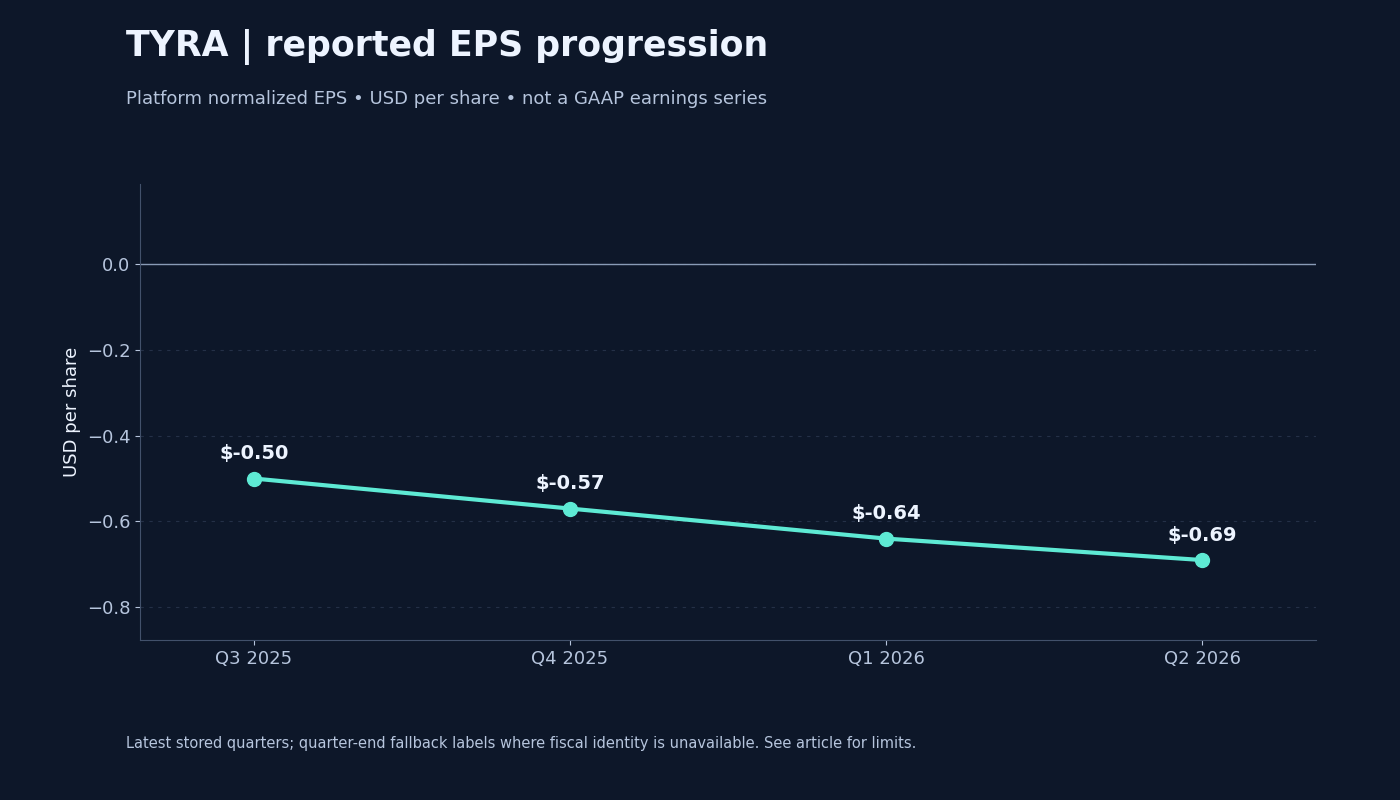
The second-quarter issuer report recorded a $45.6 million net loss and $353.9 million in cash and securities at June 30, with a then-estimated runway into the second half of 2028. The company later announced pricing of a $400 million offering in September; the June balance should therefore not be presented as today’s cash balance. Offering proceeds and current cash are also different quantities. Quarterly results, company financing notice
With no product-revenue base in the stored financial sequence, a conventional net profit margin is not meaningful. Zero revenue does not turn a negative earnings figure into a zero-percent margin. Cash use, dilution and the next clinical evidence are more useful financial questions at this stage.
Ratings and the short-term test
Price Score slipped from 3.24 to 3.12 out of five. Momentum declined to 46.43 out of 100, while AI Score was 2.38 out of five. The combination supports a cautious interpretation: TYRA passed a recovery screen, but the broader signals do not yet show decisive strengthening.
Tectonic and Assembly are useful fellow clinical-stage comparisons for funding and milestone timing. Their different disease targets prevent direct conclusions about drug efficacy. The shared risk is that an attractive chart can be overwhelmed by clinical disappointment or a wider retreat from speculative biotechnology stocks.
For the coming week, TYRA is a watch for confirmation. Investor access and a defined clinical story support attention; weak volume acceleration, continuing losses and binary development risk limit conviction. A sustained move toward and through the 50-day average on stronger participation would improve the case, while renewed weakness near recent closes would argue that the screen identified possibility before buyers supplied proof.