
Strong management and a growing order book do not insulate an AI hardware stock from changing investor appetite for the entire buildout. When enthusiasm for data centers attracts capital, several suppliers can benefit together. If financing, power availability or project economics become harder to assess, even a well-run supplier can face pressure.
Before treating a low earnings multiple or a sharp weekly rebound as an opportunity, it helps to ask whether the surrounding industry is becoming stronger. Earnings calls and customer commitments establish the company’s case; industry participation helps show whether the market supports it. Neither explains a constant share of returns, and a rising theme does not make every supplier equally attractive.
Key takeaways
- The parent industry returned -12.06% from October 30 close to November 6 close.
- 9.4% of members with usable individual averages traded above their 50-DMA.
- Cisco’s November 12 results provide a confirmed networking-demand check; the outcome is unknown.
Where the weekly trend stands
The platform’s AI Infrastructure & Hardware index ranked 14 of 15 industries for the completed week. It finished 18.17% below its own 50-session moving average. That leaves technical recovery incomplete, even if individual stocks or a single session rebound.
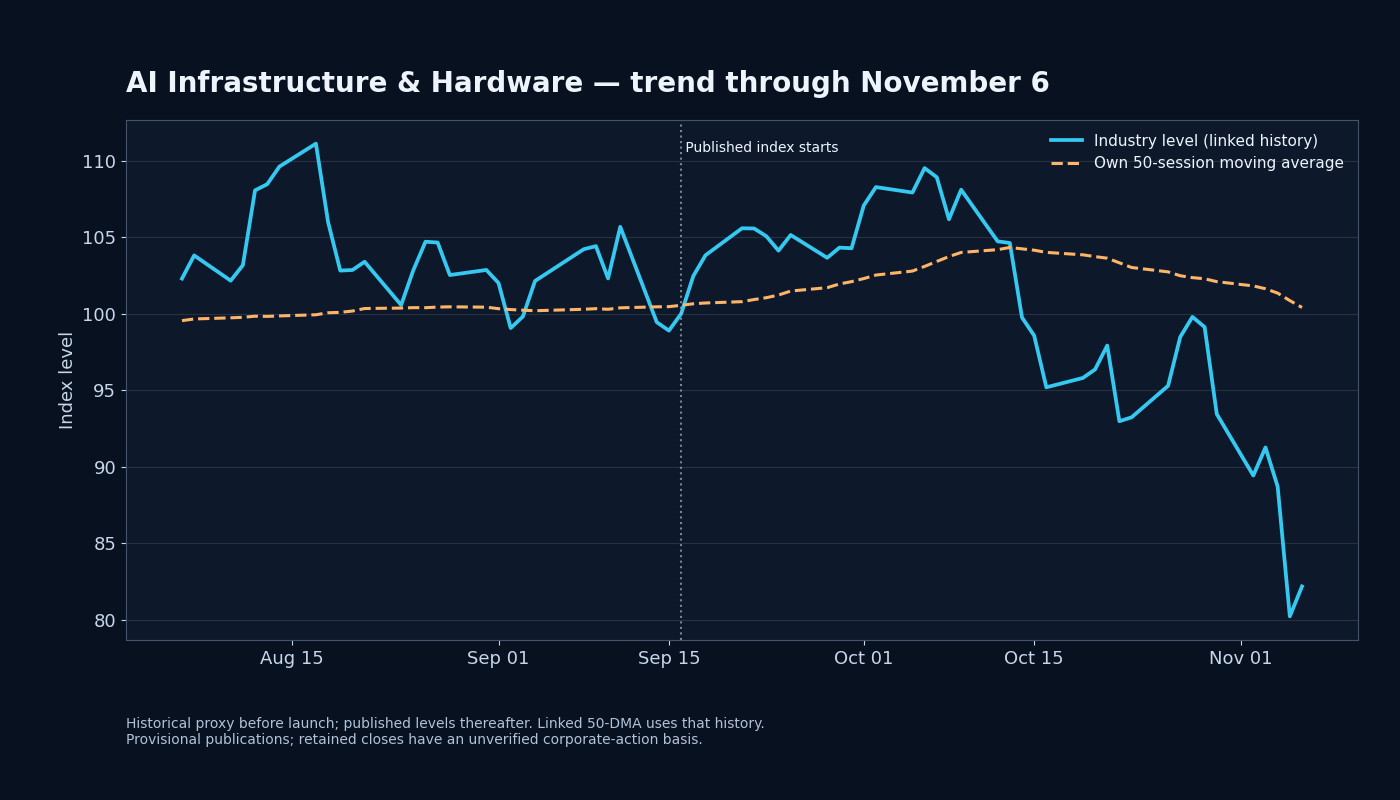
Before the vertical launch marker, the chart uses reconstructed historical levels; afterward it uses published index levels. The moving average uses that linked history. Publications remain provisional, and the retained price history has not been fully validated for corporate actions. These limitations matter when an unusually large move dominates a comparison.
Breadth adds another perspective: 9.4% of members with usable stock-level averages finished above them. Participation below half leaves the group dependent on a narrower set of successful names. Breadth covers a wider membership than the selected index, so the two measures can disagree without either being a company recommendation.
What the subindustry split reveals
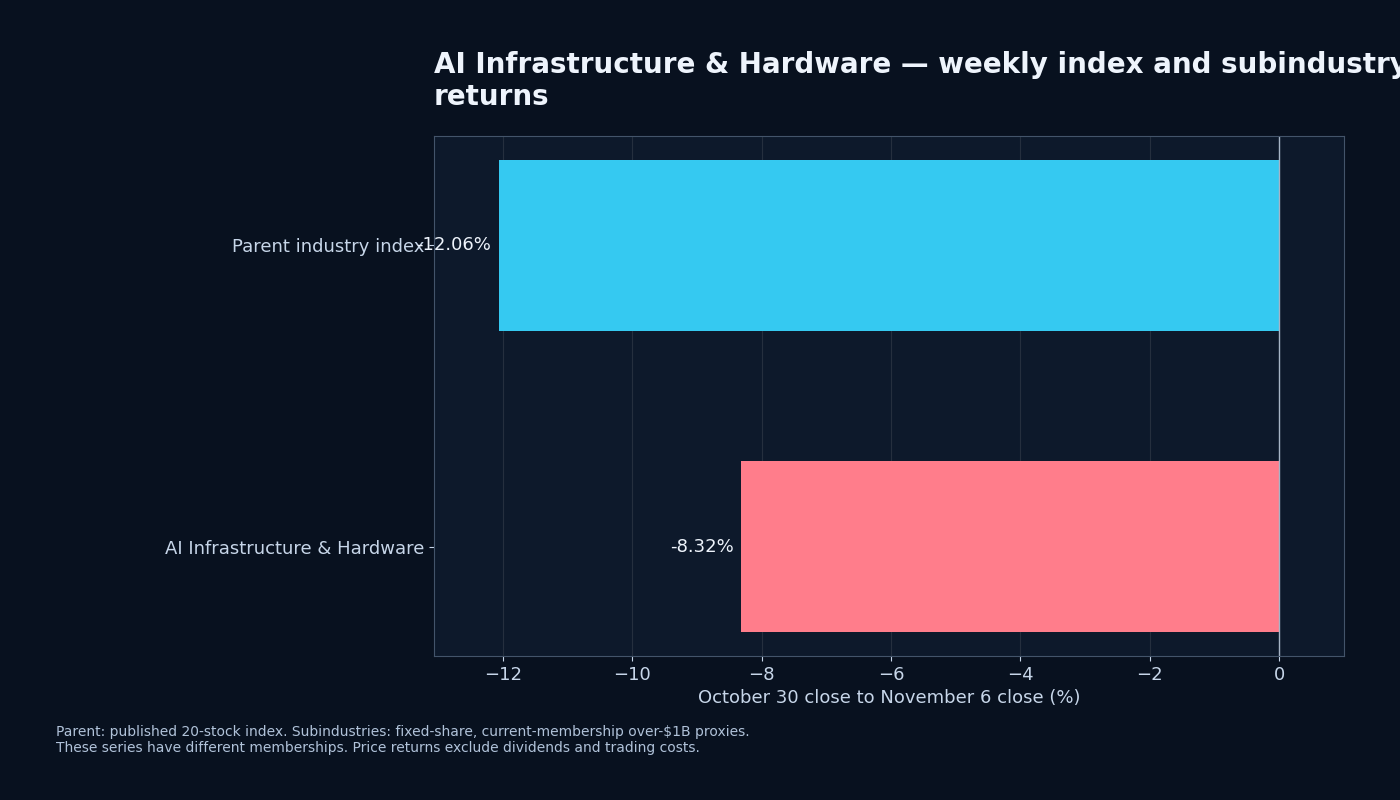
The parent index contains 20 selected stocks. Subindustry comparisons use broader over-$1B memberships, equal October 30 allocations and fixed shares through the week. Their returns are comparisons between different baskets, not estimates of contributions to the parent index.
The wider AI Infrastructure & Hardware proxy lost 8.32%, compared with the parent index’s 12.06% decline. All 85 eligible proxy members had the required weekly closes. The smaller fall does not establish a healthy industry: the broader proxy still finished 19.91% below its own 50-DMA. The selected index and the broader membership both point to weakness, although their compositions give them different returns.
This difference also matters for company selection. An industry assignment is a starting point for research, not proof that every member has the same exposure to data-center investment. Optical networking, servers and other hardware can face different customer budgets, product cycles and delivery constraints. A recovery led by one product category may leave another behind.
Results and companies to watch
LITE illustrates the gap between operating growth and share-price performance. In its November 2 fiscal first-quarter release, Lumentum reported revenue of $1.263 billion, up 136.5% from a year earlier, and guided next-quarter revenue to $1.575–$1.625 billion. That guidance describes management’s expectations, not completed sales. The shares nevertheless returned -35.94% across October 30–November 6. This weekly interval contains broader market influences and cannot isolate the earnings reaction.
The wider picture was uneven: ANET returned +1.15%, while DELL fell -22.57% over the same week. Their different paths argue for checking orders, customer concentration and delivery economics company by company. A less negative stock is showing relative resilience, but that alone does not establish attractive valuation or a confirmed industry recovery.
What could change the view
Cisco’s confirmed schedule puts fiscal first-quarter results after the November 12 close, followed by a 4:30 p.m. ET call. Investors can look for evidence on networking orders, customer investment and margins. It is a useful adjacent-industry check rather than a result already known for the entire hardware group.
The BLS calendar schedules October CPI for November 10 and PPI for November 13, both at 8:30 a.m. ET. Inflation can affect financing costs and the economics of large construction projects. Cooler readings could help the backdrop; hotter readings could renew pressure on funding and valuations. Neither outcome is assumed here.
The next-week parent-industry assessment is 1/5, very weak, for November 9–13. It combines recent trend strength with a researched assessment of events; it is not the stock-level Price Score or a probability of gains. It weights technical conditions 60% and event balance 40%. Where a reduced-history estimate is discussed, it uses one consistent cohort throughout its technical calculations and remains explicitly estimated.
The constructive case needs funded orders to turn into deliveries and cash flow, alongside a broader improvement in stock participation. Delayed projects, concentrated customers or renewed weekly lows would weaken that case. For now, a cautious group assessment can coexist with genuine operating growth at selected suppliers; the price trend still needs repair.