
In biotechnology, a compelling scientific program and experienced management can coexist with a weak share price. Clinical results remain company-specific, yet the availability of funding and investors’ appetite for development risk can influence many stocks together. When capital becomes harder to obtain, promising businesses may still face a tougher market.
That makes industry context useful before interpreting a low valuation or a sudden weekly gain. Is the move supported by a verified company milestone, improving financing conditions, or simply a short-lived rebound across peers? There is no fixed industry share of every stock’s return, and a trial result can overwhelm the broader trend. The group analysis provides context without replacing the individual scientific and financial case.
Key takeaways
- The parent industry returned -0.14% from October 30 close to November 6 close.
- 35.2% of members with usable individual averages traded above their 50-DMA.
- Oruka’s November 10–11 conferences and Absci’s November 12 results are upcoming events, not promised clinical outcomes.
Where the weekly trend stands
The platform’s Biotechnology index ranked 8 of 15 industries for the completed week. It finished 2.63% above its own 50-session moving average. That provides a more constructive starting trend, though it does not remove company-specific risks.
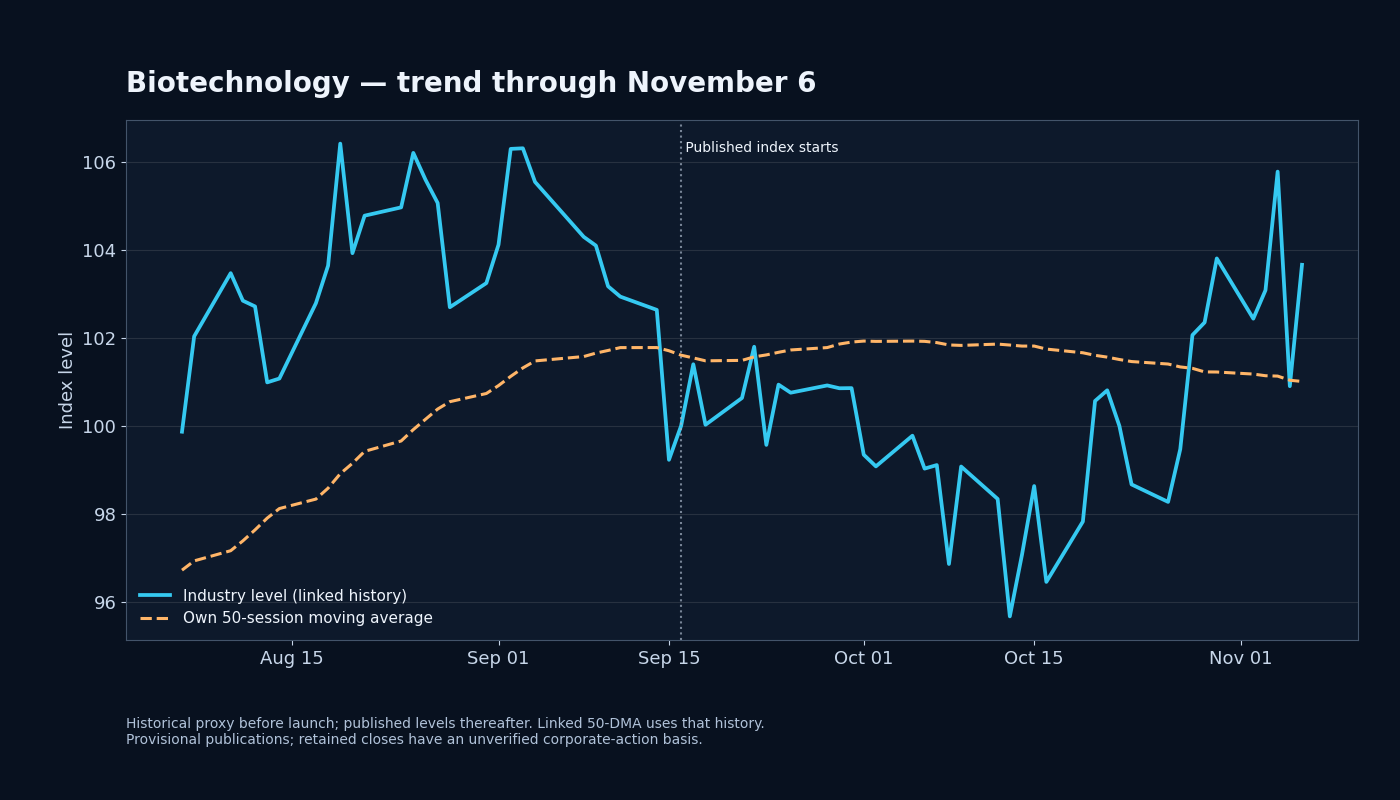
Before the vertical launch marker, the chart uses reconstructed historical levels; afterward it uses published index levels. The moving average uses that linked history. Publications remain provisional, and the retained price history has not been fully validated for corporate actions. These limitations matter when an unusually large move dominates a comparison.
Breadth adds another perspective: 35.2% of members with usable stock-level averages finished above them. Participation below half leaves the group dependent on a narrower set of successful names. Breadth covers a wider membership than the selected index, so the two measures can disagree without either being a company recommendation.
What the subindustry split reveals
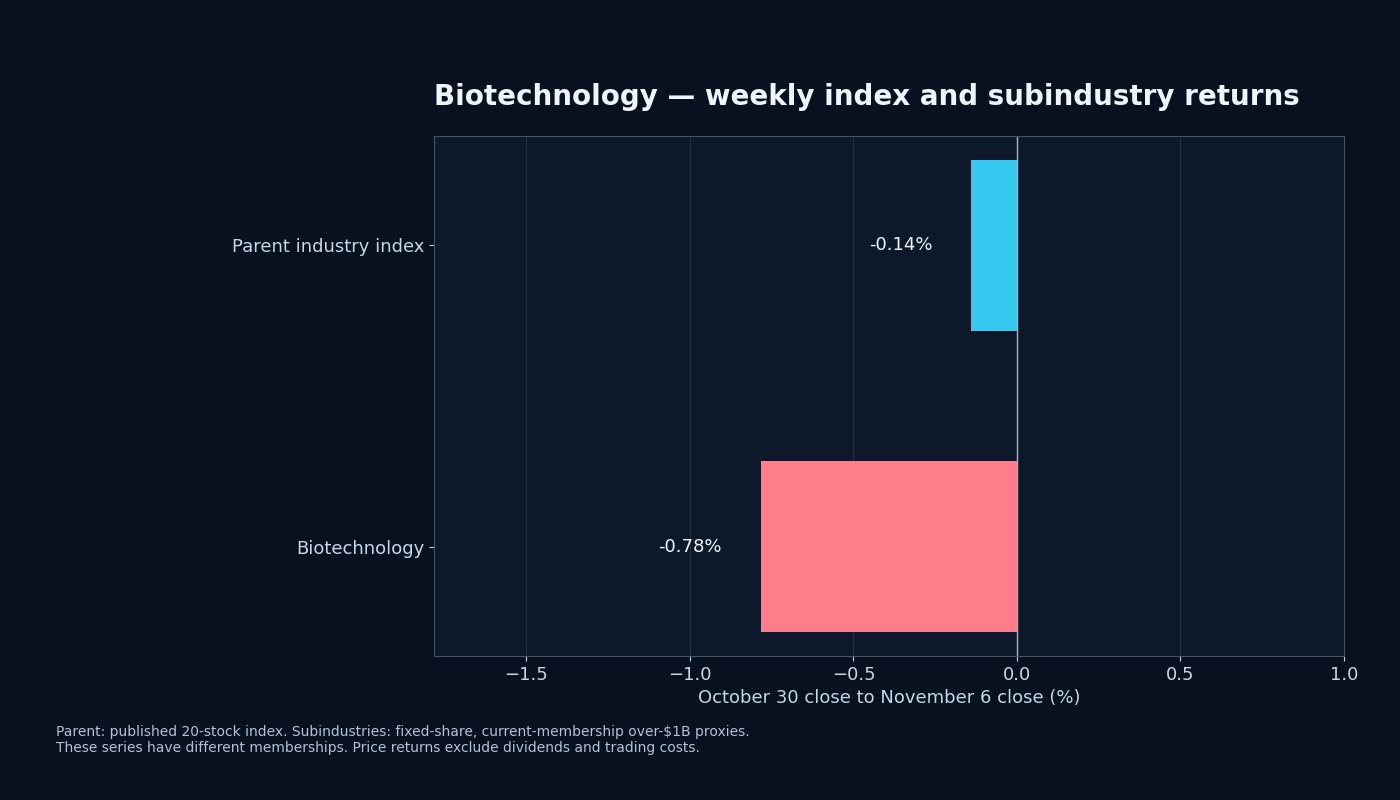
The parent index contains 20 selected stocks. Subindustry comparisons use broader over-$1B memberships, equal October 30 allocations and fixed shares through the week. Their returns are comparisons between different baskets, not estimates of contributions to the parent index.
The wider Biotechnology proxy slipped 0.78%, based on 166 of 167 eligible stocks with complete weekly prices. Its weaker return than the selected index reinforces the point that a few successful names do not describe the whole group. The distinction is especially important when a clinical event can move one company far more than its peers.
Four members lack part of the historical sequence needed for a full-cohort 50-DMA. Using the other 162 of 166 stocks, or 97.6%, gives an estimated distance of 5.28% below that cohort’s moving average and an estimated 3/5 mixed next-week assessment. Removing those four changes the weekly return by only 0.08 percentage point, but it can still underrepresent newer or less consistently priced stocks. The estimate is labelled separately from the complete-group calculation.
Results and companies to watch
GMAB reported nine-month results on November 5: revenue rose 22% to $3.238 billion, supported by royalties and product sales. That is a nine-month comparison, not a single-quarter growth rate. Its shares returned -6.01% for the reviewed week, showing why business progress and short-term price performance should be assessed separately.
Genmab, REPL and ORKA appear in the platform’s public Real-Money selection dated October 31. Replimune returned +22.77% and Oruka +6.18% over October 30–November 6. Those observations describe current public constituents, not their contribution to the industry index. No common clinical explanation is assigned to their different moves.
PVLA has already delivered its quarterly update. Its November 5 release reported FDA priority review and a February 28, 2027 target action date. Approval remains uncertain. That future regulatory milestone should not be confused with a new earnings release or an FDA decision scheduled for the coming week.
What could change the view
Oruka’s confirmed conference notice lists Guggenheim on November 10 at 11 a.m. EST and Stifel on November 11 at 4 p.m. EST. Management may clarify existing development plans, but a presentation date is not a promise of new study results. Watch the substance of any disclosure, including trial design and funding needs.
Absci’s results notice confirms a release before the November 12 open and an 8 a.m. ET call. Cash use, development progress and the outlook are relevant checks; the results are unknown. These company-specific events can outweigh the broader market for an individual stock.
The next-week parent-industry assessment is 3/5, mixed, for November 9–13. It combines recent trend strength with a researched assessment of events; it is not the stock-level Price Score or a probability of gains. It weights technical conditions 60% and event balance 40%. Where a reduced-history estimate is discussed, it uses one consistent cohort throughout its technical calculations and remains explicitly estimated.
A more constructive view would require stronger participation and verified development progress backed by adequate cash. Financing pressure, dilution or trial delays would work in the opposite direction. The mixed assessment reflects that balance: selected companies can advance, while the broad group still lacks a convincing, widely shared recovery.