
Key takeaways
- The selected biotech index rose 0.38%, while the broader weekly member basket lost 0.78%.
- The index stood 2.89% above its 50-DMA, but just 38.89% of eligible stocks were above their own averages.
- Absci expects a December clinical update; that remains a future milestone, not a completed readout.
Biotechnology combines scientific progress with the need to finance years of development. A promising treatment can create a company-specific opportunity, but funding conditions and investor appetite for clinical risk still shape the price paid for that potential.
Industry strength is valuable context rather than a substitute for trial evidence. A better group trend can help multiple developers, while a weak financing backdrop can pressure even encouraging programs. Dates and the nature of the expected data matter as much as the theme.
What the completed week shows
The published industry index returned +0.38% between the November 6 and November 13 closes, placing it 12th of the 15 parent industries for the reviewed week. This includes Monday’s move from the previous Friday; a chart beginning at Monday’s close would describe a different period. The latest index level is 104.05.
Participation provides another view. Among the current above-$1B members with a complete weekly price record, 85 advanced, 80 declined and 1 was unchanged. Their equal-weight mean return was -0.78%. That broader member average is different from the selected 20-stock published index, so the two should not be presented as interchangeable returns.
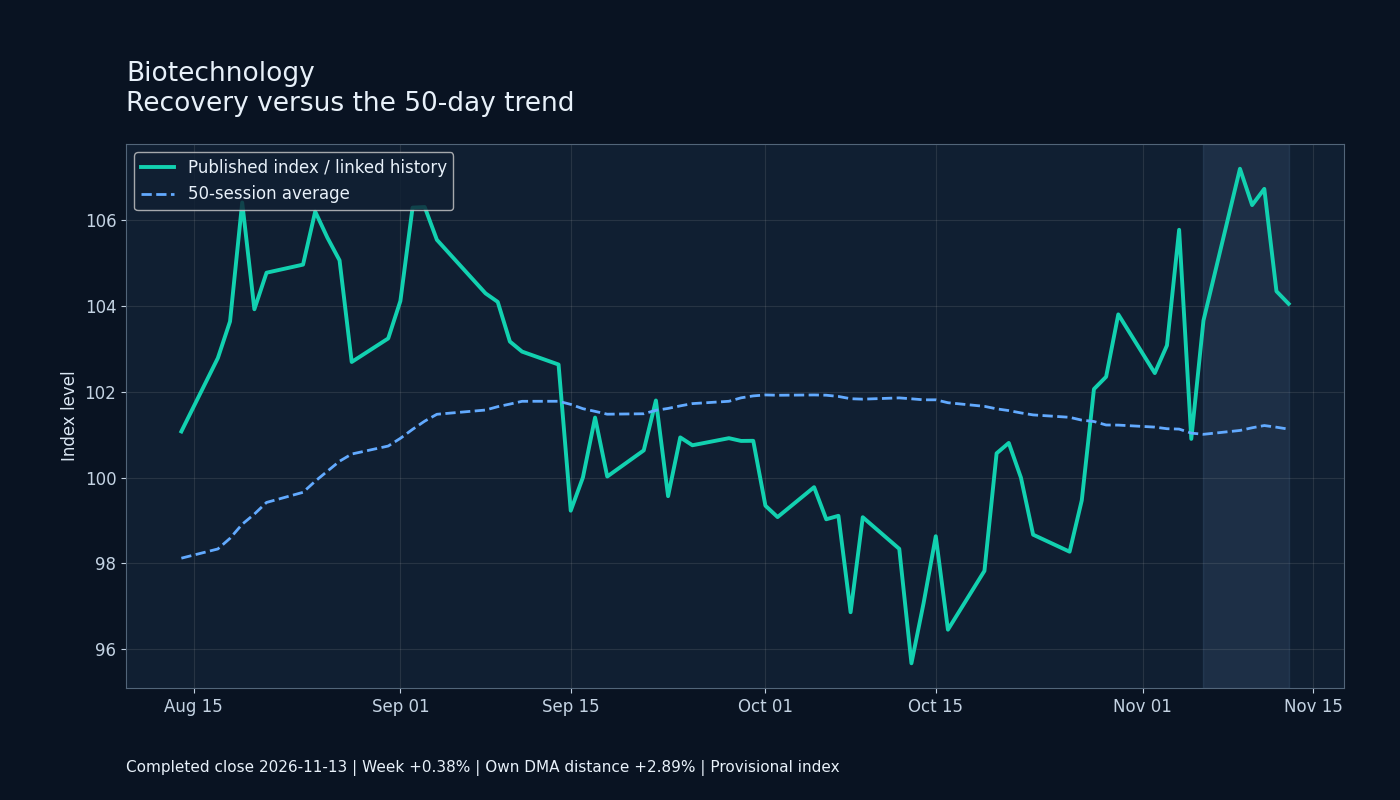
The shaded final week shows the latest move in the context of the longer trend. Linked history and provisional index status remain visible.
What the moving averages reveal
The index ended +2.89% from its own 50-day average of 101.13. Across eligible members with valid individual averages, 38.89% stood above their own 50-day lines. Here, breadth is the share of stocks above their averages; an individual stock’s DMA distance is a different measure. Neither establishes that a business is undervalued.
The technical phase is best described as above 50-DMA; consolidation. A positive week below the moving average can mark a recovery attempt, while strength above it offers a different starting position. In both cases, follow-through from multiple members matters more than assuming the latest week will repeat.
Where the subindustries differ
Biotechnology
Its fixed-cohort proxy returned -0.78%, using 166 of 167 eligible members with complete weekly closes. Clinical milestones, cash runway and commercialization progress need separate company-level checks. The broader group trend provides context rather than a substitute for program evidence.
The strict 50-day assessment is unavailable because the full frozen weekly cohort lacks a continuous common history. A separately labeled complete-history estimate is 3/5, retaining 162 of 166 weekly members (97.6%). Its weekly return changes by -0.09 percentage points. It excludes sparse-history stocks and may therefore be biased.
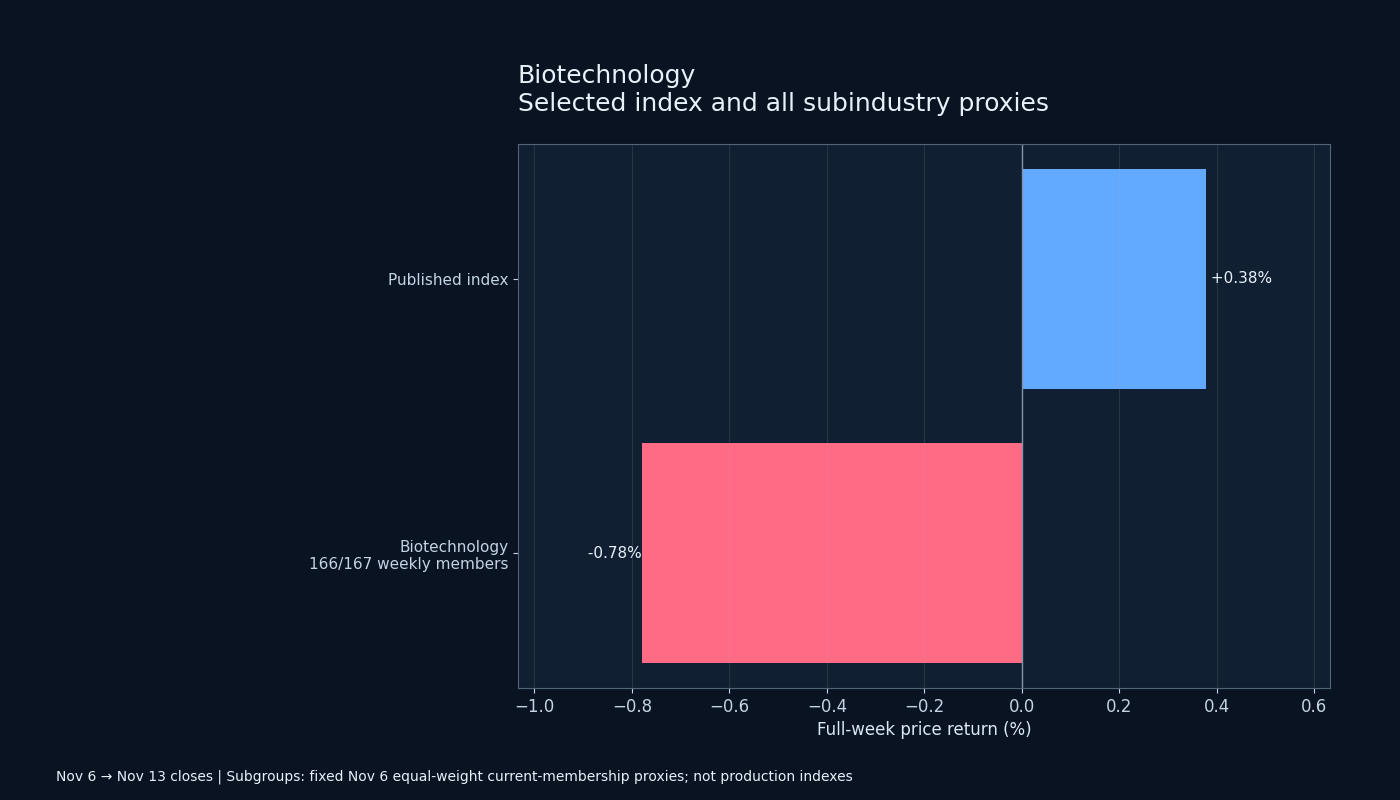
Published index and retrospective subgroup proxies use different baskets. The chart is a comparison of completed returns, not a forecast or a historical investable strategy.
Company evidence and the coming week
Absci’s November 12 update points to a December 2026 proof-of-concept expectation. That is a prospective clinical milestone beyond the coming week, not a verified successful readout or a reason to label next week a clinical catalyst for every developer.
Within the current industry membership, LQDA (+29.30%), TNGX (+18.60%), PRAX (+18.19%) were among the strongest complete-week returns. At the other end, IBRX (-30.28%), IONS (-26.28%), LEGN (-25.21%) illustrate the dispersion. These are retrospective company examples, not a claim that they caused the index move or were selected before it occurred. Their returns use saved platform closes, not live weekend quotes.
The current public Real-Money roster also includes Liquidia Corporation (LQDA), grouped in this industry. Its latest stored close is $57.41 on 2026-11-13. This connects the industry outlook to a live portfolio holding; the completed-week industry and stock examples above are historical context, not performance earned by a newly selected portfolio. For Liquidia, commercial execution and funding should be assessed separately from other developers’ clinical announcements.
A practical next-week assessment
The parent’s strict next-week assessment is 3/5, a mixed trend reading rather than a predicted return. It gives 60% weight to the technical assessment and 40% to the researched event balance. The technical portion combines weekly-return bands and distance from the industry’s own 50-day line equally. The event balance is 3/5: opposing outcomes have been considered, rather than treating the presence of an earnings date as a bullish event.
The upside case is straightforward: verified trial progress and adequate funding improve program visibility. The downside case is that clinical setbacks, delayed milestones or dilution offset scientific progress. Confirmation would involve broader participation, a stable or rising own moving average and operating evidence that supports the price move. A failed rebound with fewer stocks participating would weaken that case even if a few individual names remained strong.
The price analysis ends at the November 13 cash close. The latest stored quantitative sentiment was published on November 13 using November 12 prices, so it is older context, not a fresh reading for Monday. Published indexes remain provisional; subgroup estimates retain their separate labels. No fixed industry share of stock returns, unverified fund flows or guaranteed next-week outcome is assumed.