
Biotechnology combines scientific progress with the need to finance years of development. A promising treatment can create a company-specific opportunity, but funding conditions and investor appetite for clinical risk still shape the price paid for that potential.
Industry strength is valuable context rather than a substitute for trial evidence. A better group trend can help multiple developers, while a weak financing backdrop can pressure even encouraging programs. Dates and the nature of the expected data matter as much as the theme.
What the completed week shows
The figures below are provisional platform measurements from stored closing prices, not independently reconciled total returns. Corporate actions and incomplete histories can distort comparisons; price leadership alone does not establish investment merit.
The proprietary platform index recorded -5.96% between the November 13 and November 20 closes, placing it 6 of the 15 parent industries for the reviewed week. This includes Monday’s move from the previous Friday; a chart beginning at Monday’s close would describe a different period. The latest index level is 97.85.
Participation provides another view. Among the current above-$1B members with a complete weekly price record, 18 advanced, 129 declined and 1 were unchanged. Their equal-weight mean return was -7.38%. That broader member average is different from the selected 20-stock published index, so the two should not be presented as interchangeable returns.
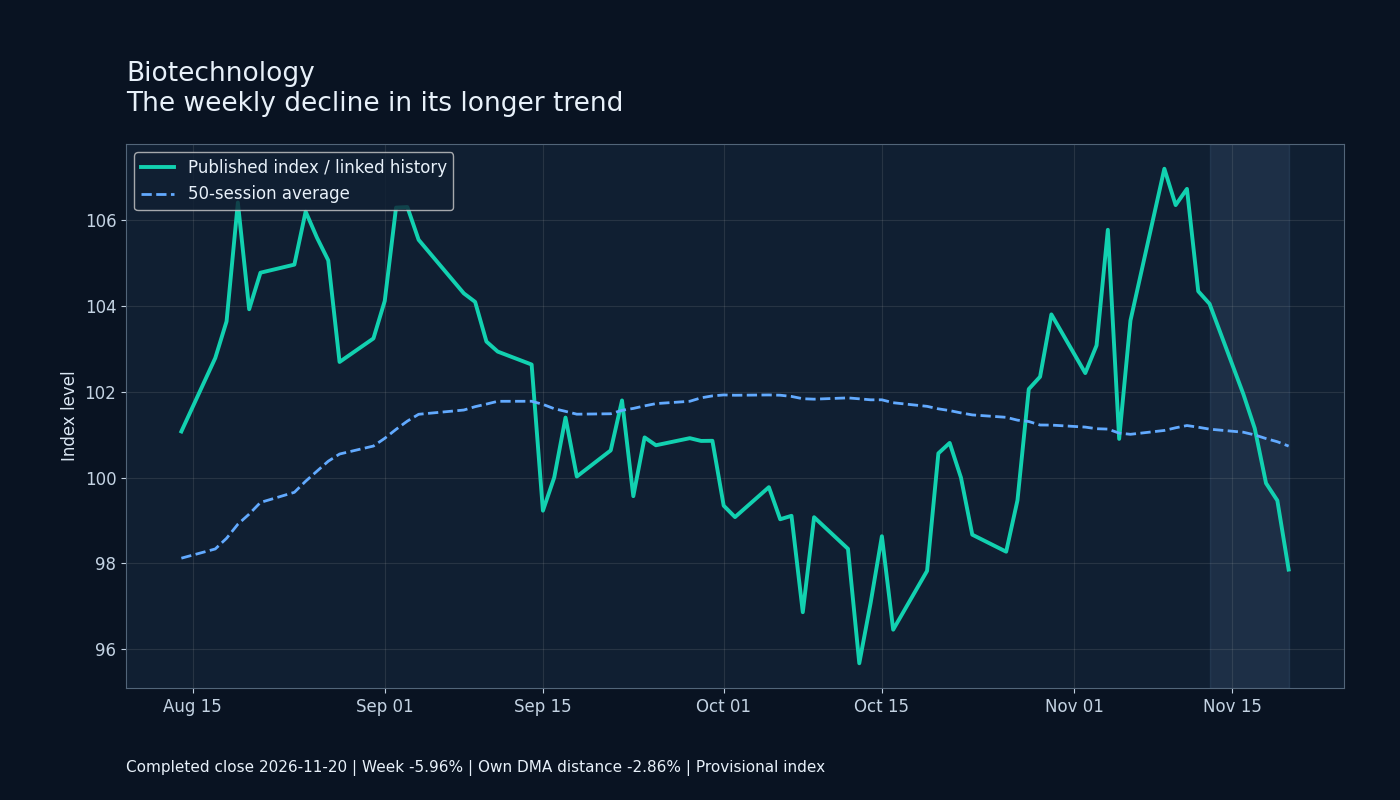
The shaded final week shows the latest move in the context of the longer trend. Linked history and provisional index status remain visible.
Reading the trend without overstating it
The index ended -2.86% from its own 50-day average of 100.73. Across eligible members with valid individual averages, 28.97% stood above their own 50-day lines. Here, breadth is the share of stocks above their averages; an individual stock’s DMA distance is a different measure. Neither establishes that a business is undervalued.
The technical phase is best described as downtrend below 50-dma. A positive week below the moving average can mark a recovery attempt, while strength above it offers a different starting position. In both cases, follow-through from multiple members matters more than assuming the latest week will repeat.
A compatible one-year comparison was not captured for this assessment; a shorter series is not presented as a one-year return.
Where the subindustries differ
Biotechnology
Its fixed-cohort proxy returned -7.38%, using 148 of 149 eligible members with complete weekly closes. No subgroup-specific issuer driver is assigned without separate verification. Orders, earnings execution and cash conversion still need company-level confirmation. A broad group signal should complement the review of individual financial results.
The strict 50-day assessment is unavailable because a common full-cohort history is not available (including an active subgroup with no eligible members). A separately labeled complete-history estimate is 2/5, retaining 145 of 148 weekly members (98.0%). Its weekly return changes by -0.02 percentage points. It excludes sparse-history stocks and may therefore be biased.
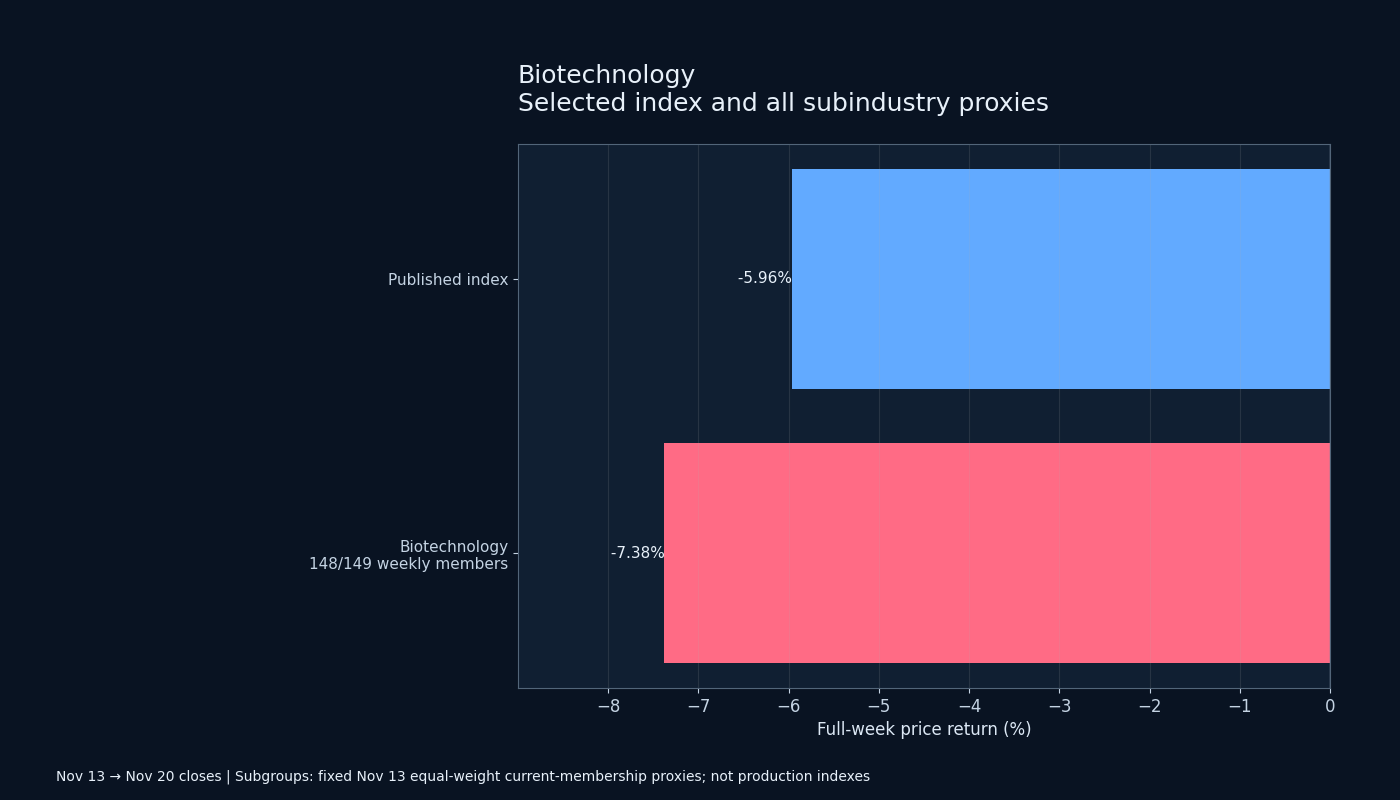
Published index and retrospective subgroup proxies use different baskets. The chart is a comparison of completed returns, not a forecast or a historical investable strategy.
Company evidence and the coming week
Summit’s November 16 SEC filing records a November 15 FDA complete-response letter announcement. Ivonescimab’s application could not be approved in its current form. The announcement precedes the cash week; its first subsequent session was November 16. This is a product-specific risk, not a verdict on unrelated programs. No particular next-week readout was confirmed.
Within the current industry membership, SLS (+73.79%), KRSA (+18.67%) were among the strongest complete-week returns. At the other end, SMMT (-29.68%), OMER (-24.47%) illustrate the dispersion. These are retrospective company examples, not a claim that they caused the index move or were selected before it occurred. Their returns use saved platform closes, not live weekend quotes.
Scholar Rock appears in the published Real-Money basket released November 21. Summit’s product-specific regulatory setback cannot establish an outcome for Scholar Rock’s separate development programs; each company needs its own clinical and financing review.
A practical next-week assessment
The parent’s strict next-week assessment is 2/5, a cautious trend reading rather than a predicted return. It gives 60% weight to the technical assessment and 40% to the researched event balance. The technical portion combines weekly-return bands and distance from the industry’s own 50-day line equally. The event balance is 3/5: Summit disclosed an FDA complete-response letter; its November 15 announcement precedes the reviewed week, although the filing and first cash-session response fall within it. No specific next-week clinical date is verified. This is an analyst judgment of no clear directional edge, not a probability or an assumed positive earnings surprise.
The upside case is straightforward: verified trial progress and adequate cash runway support selective recovery. The downside case is that clinical setbacks or financing needs overwhelm isolated positive evidence. Confirmation would involve broader participation, a stable or rising own moving average and operating evidence that supports the price move. A failed rebound with fewer stocks participating would weaken that case even if a few individual names remained strong.
The price analysis ends at the November 20 cash close. Quantitative sentiment was refreshed November 21 from completed November 20 prices. It is price-derived context, not fresh news sentiment. The outlook covers November 23–27, with Thanksgiving closed and Friday shortened. Published indexes remain provisional; subgroup estimates retain their separate labels. No fixed industry share of stock returns, unverified fund flows or guaranteed next-week outcome is assumed.
Explore the industry charts and company comparisons to continue the research.