
A capable clean-energy management team cannot control how readily investors fund the wider industry. A promising technology or rising demand may support the business, while changes in financing conditions and policy expectations still weigh on its shares. When enthusiasm returns, the same thematic interest can help several companies together without making their risks identical.
That is why earnings expectations, valuation and recent momentum need an industry check. Does a recovery reflect improving operations across the group, or a renewed appetite for the theme? No fixed percentage captures that relationship for every stock. Charging, storage and nuclear-related businesses face different paths to revenue, so the analysis below looks for support within each subindustry rather than assuming one common investment case.
Key takeaways
- The parent industry returned +0.76% from October 30 close to November 6 close.
- 16.7% of members with usable individual averages traded above their 50-DMA.
- EVgo’s November 9 call and Amprius’s November 11 call will test demand, execution and cash requirements.
Where the weekly trend stands
The platform’s Clean & Nuclear Energy index ranked 5 of 15 industries for the completed week. It finished 14.23% below its own 50-session moving average. That leaves technical recovery incomplete, even if individual stocks or a single session rebound.
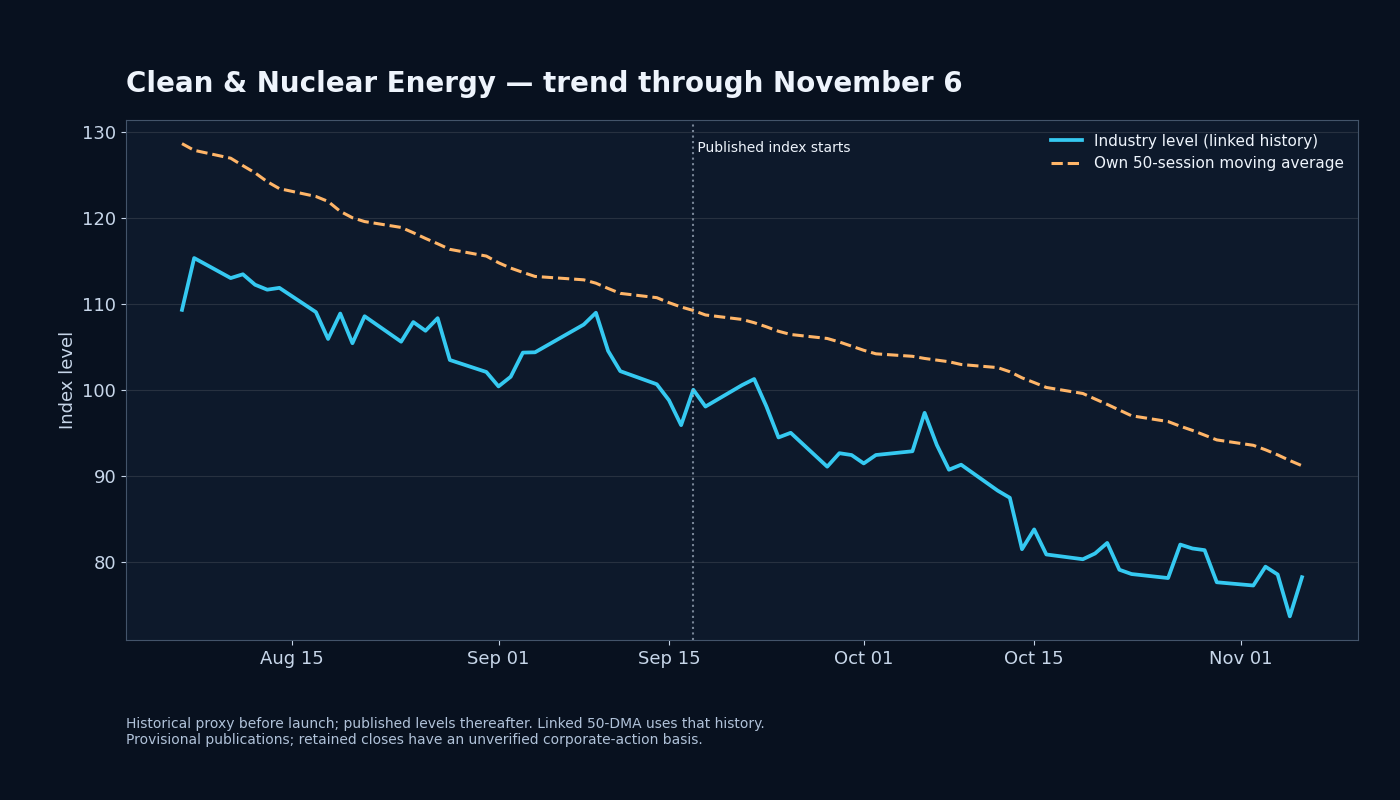
Before the vertical launch marker, the chart uses reconstructed historical levels; afterward it uses published index levels. The moving average uses that linked history. Publications remain provisional, and the retained price history has not been fully validated for corporate actions. These limitations matter when an unusually large move dominates a comparison.
Breadth adds another perspective: 16.7% of members with usable stock-level averages finished above them. Participation below half leaves the group dependent on a narrower set of successful names. Breadth covers a wider membership than the selected index, so the two measures can disagree without either being a company recommendation.
What the subindustry split reveals
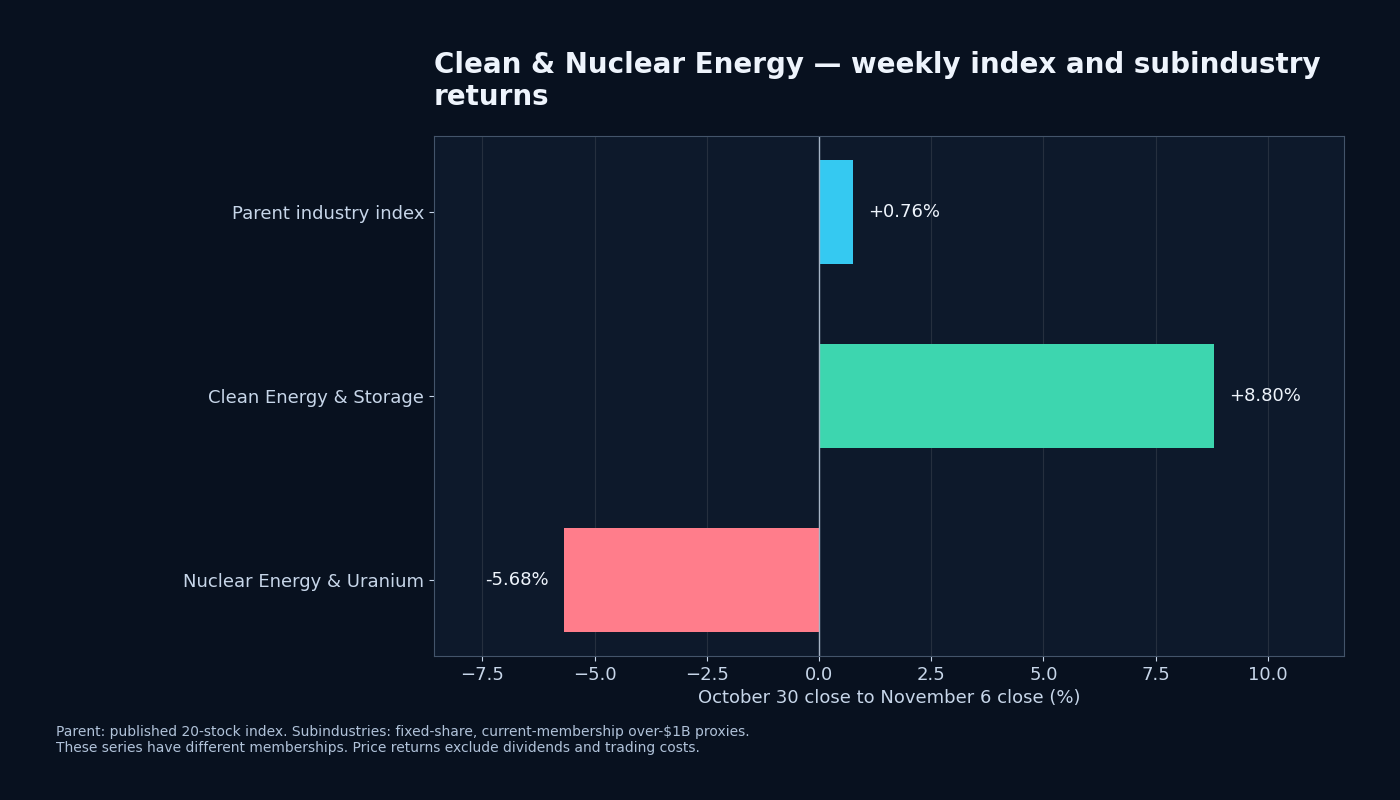
The parent index contains 20 selected stocks. Subindustry comparisons use broader over-$1B memberships, equal October 30 allocations and fixed shares through the week. Their returns are comparisons between different baskets, not estimates of contributions to the parent index.
Clean Energy & Storage gained 8.80%, using all 12 eligible members with complete weekly prices. Even after that strong week, the proxy remained 8.10% below its own 50-DMA. The combination describes a rebound within a still-damaged trend. It is stronger evidence of recent buying than proof that the longer-term recovery is complete.
Nuclear Energy & Uranium moved the other way, falling 5.68% across its 12-member proxy and finishing 22.32% below its moving average. Nuclear power, uranium supply and storage economics should therefore not be folded into one optimistic energy-transition story. The funding needs, customer contracts and route to cash generation differ materially between them.
Results and companies to watch
The weekly contrast also appeared in individual stocks: SHLS returned +40.00%, while BE returned -14.73%. Those are measured price moves, not evidence of a single shared catalyst. Investors still need to connect each company’s demand, margins and cash requirements to its own operating disclosures.
AMPX returned +1.51% ahead of its scheduled update. For a battery supplier, production progress is only part of the question: scaling output must be considered alongside costs, customer demand and available funding. The coming call can provide evidence, but a scheduled event does not establish an earnings beat or a favorable price reaction.
What could change the view
EVgo’s confirmed notice schedules results before a November 9, 9 a.m. ET webcast. Utilization, rollout spending and liquidity can show whether demand is translating into a more sustainable business. EVgo is an additional calendar read-through outside the over-$1B proxy, rather than an extra constituent inserted into that comparison.
Amprius’s confirmed announcement puts its call on November 11 at 8:30 a.m. ET, with results released beforehand. Orders, production and cash use are the practical checks. Higher output without adequate margins or liquidity would provide a less encouraging signal than growth supported by improving economics.
CEG has a November 9, 9 a.m. ET call on its issuer event calendar. It offers context on power demand and contracts; it is not a uranium-price forecast or a mine-output report. Results remain upcoming. Inflation releases can also influence funding conditions across these capital-intensive businesses.
The next-week parent-industry assessment is 2/5, weak, for November 9–13. It combines recent trend strength with a researched assessment of events; it is not the stock-level Price Score or a probability of gains. It weights technical conditions 60% and event balance 40%. Where a reduced-history estimate is discussed, it uses one consistent cohort throughout its technical calculations and remains explicitly estimated.
The next positive step would be stronger demand and execution supported by credible funding, followed by more stocks regaining their moving averages. Persistent cash burn, dilution or construction-cost pressure could undermine the rebound. Clean storage’s weekly strength deserves attention, but the nuclear divergence and weak broader participation keep the overall view cautious.