
A cloud or cybersecurity company may report healthy growth while its shares struggle alongside its peers. Investors weigh the company’s contracts and margins, but they also reconsider how much to pay for growth across the group. Changes in customer budgets or the cost of capital can affect several businesses at once.
Company research therefore needs a wider lens. Forward earnings estimates and valuation multiples help explain the business, while industry trends help distinguish a broadly supported recovery from an isolated bounce. The relationship changes with market conditions rather than following a universal percentage. Here, the aim is to see whether company progress is gaining support from the surrounding market or still working against it.
Key takeaways
- The parent industry returned -8.33% from October 30 close to November 6 close.
- 45.2% of members with usable individual averages traded above their 50-DMA.
- Cloudflare’s reported growth and Cisco’s upcoming November 12 results create different, dated demand checks.
Where the weekly trend stands
The platform’s Cloud Infrastructure & Cybersecurity index ranked 12 of 15 industries for the completed week. It finished 7.51% below its own 50-session moving average. That leaves technical recovery incomplete, even if individual stocks or a single session rebound.
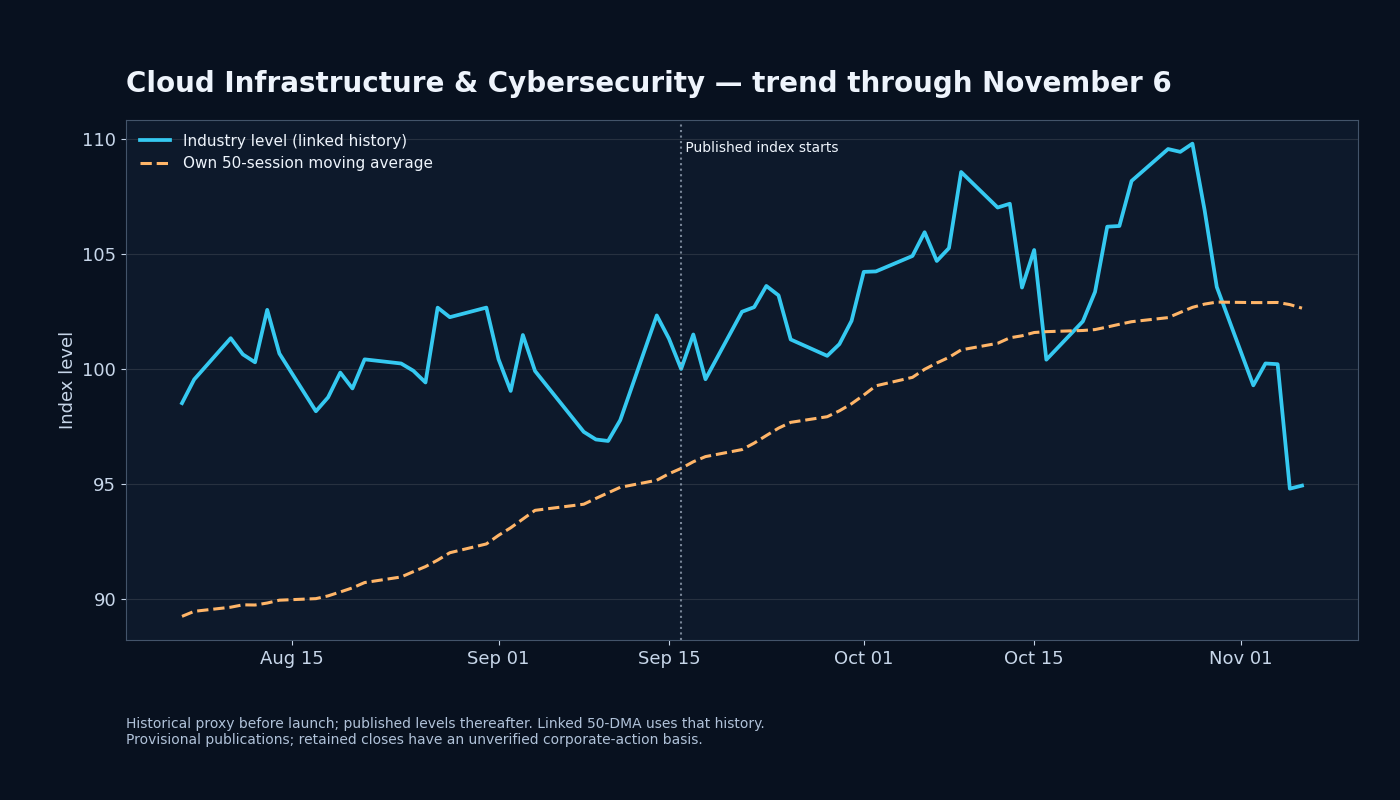
Before the vertical launch marker, the chart uses reconstructed historical levels; afterward it uses published index levels. The moving average uses that linked history. Publications remain provisional, and the retained price history has not been fully validated for corporate actions. These limitations matter when an unusually large move dominates a comparison.
Breadth adds another perspective: 45.2% of members with usable stock-level averages finished above them. Participation below half leaves the group dependent on a narrower set of successful names. Breadth covers a wider membership than the selected index, so the two measures can disagree without either being a company recommendation.
What the subindustry split reveals
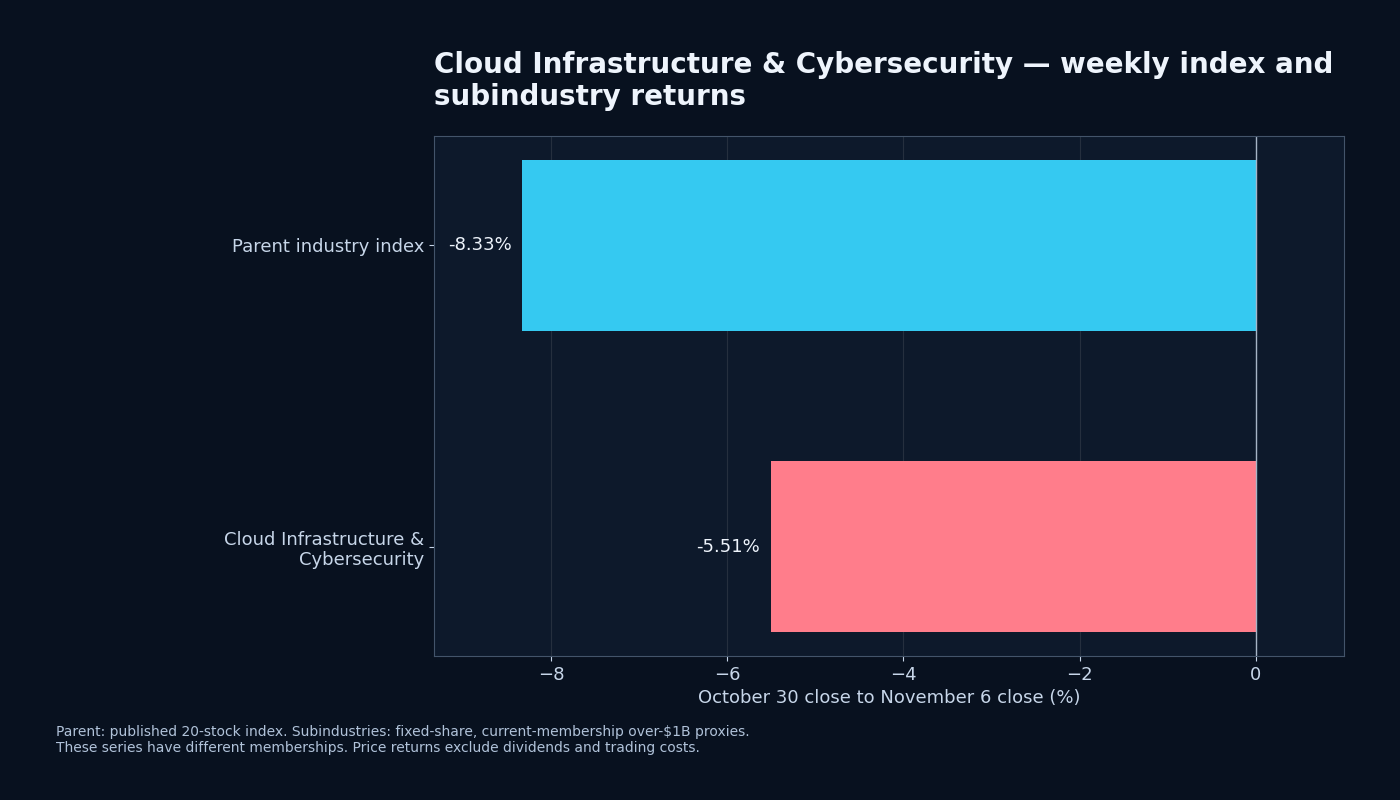
The parent index contains 20 selected stocks. Subindustry comparisons use broader over-$1B memberships, equal October 30 allocations and fixed shares through the week. Their returns are comparisons between different baskets, not estimates of contributions to the parent index.
The broader Cloud Infrastructure & Cybersecurity proxy fell 5.51%, using 74 of 74 eligible members with complete weekly prices. That was less severe than the selected index’s decline, but the proxy remained 8.67% below its own 50-DMA. Different membership explains the return gap; it does not turn two weak series into independent evidence of recovery.
Cloud platforms and security providers also face different customer decisions. A business may protect essential security spending while slowing a separate infrastructure project. The useful company checks are therefore contract quality, spending commitments, delivery costs and cash generation. One supplier’s strong revenue report cannot establish that every customer budget or vendor margin is improving.
Results and companies to watch
NET reported third-quarter results on November 5: revenue rose 39% to $782.5 million. The accounting bases matter: GAAP loss was $0.10 per share, while non-GAAP earnings were $0.38 per diluted share. These are different measures, not interchangeable descriptions of profitability. Continued growth supports the demand case; the gap keeps cost discipline and earnings quality relevant.
Cloudflare returned -4.26% across the full reviewed week. CRWD and PANW fell -13.39% and -14.22%, respectively. Those common negative directions show broad price pressure, but they do not establish a common earnings disappointment. The weekly interval also includes market-level influences and should not be presented as an isolated reaction to Cloudflare’s announcement.
What could change the view
Cisco’s scheduled fiscal first-quarter release follows the November 12 close, with a 4:30 p.m. ET call. Its networking and security exposure makes customer spending and forward guidance useful checks. Treat the event as a source of new evidence; its outcome cannot be inferred from another company’s earlier results.
The BLS release calendar lists CPI on November 10 and PPI on November 13, both at 8:30 a.m. ET. Softer inflation could ease financing and valuation pressure. Hotter readings could offset good company results by making investors less willing to pay for future growth. This is a conditional transmission mechanism, not a forecast of either release.
The next-week parent-industry assessment is 2/5, weak, for November 9–13. It combines recent trend strength with a researched assessment of events; it is not the stock-level Price Score or a probability of gains. It weights technical conditions 60% and event balance 40%. Where a reduced-history estimate is discussed, it uses one consistent cohort throughout its technical calculations and remains explicitly estimated.
A more durable recovery needs improving participation and customer evidence extending beyond one company. Slower commitments, weak cash conversion or renewed lows would challenge it. For now, demand growth at selected suppliers and a weak industry price trend can both be true; the next step is to see whether operating progress begins to support a broader recovery.