
Key takeaways
- The selected industrial index fell 1.55% for October 30–November 6 and ended only 0.41% above its 50-DMA.
- Broader proxies lost 1.25% in aerospace and defense, 1.36% in transport and business services, and 3.72% in construction.
- Only 48.6% of members with usable averages were above their own 50-DMA, leaving limited room to call the recovery broad.
Industrials are close to a technical dividing line. The selected index ranked 10th of 15 after a weaker week, while its small cushion above the 50-day average contrasted with declining broader subindustry proxies. That combination points to uneven resilience, not a confirmed improvement in the whole industrial cycle.
A strong order book and capable management do not remove the influence of the wider industrial cycle. Investors may become more cautious about project funding, procurement or economic activity, putting pressure on several companies despite sound individual operations. Company-specific progress can take longer to translate into share-price strength in that environment.
Before interpreting a valuation discount or a short-term rally as an opportunity, it helps to examine the group around it. Broad participation offers different evidence from a move led by a handful of stocks. Industry influence varies with conditions and is not a fixed share of every return. Aerospace, construction and transport also need distinct checks, because the same economic news can affect their customers and costs differently.
What the industry trend shows
At the November 6 close, the index stood 0.41% above its own 50-session moving average. That average tracks the recent direction of the group, rather than the value of its businesses. Holding above it supports a stronger trend, although a pullback remains possible.
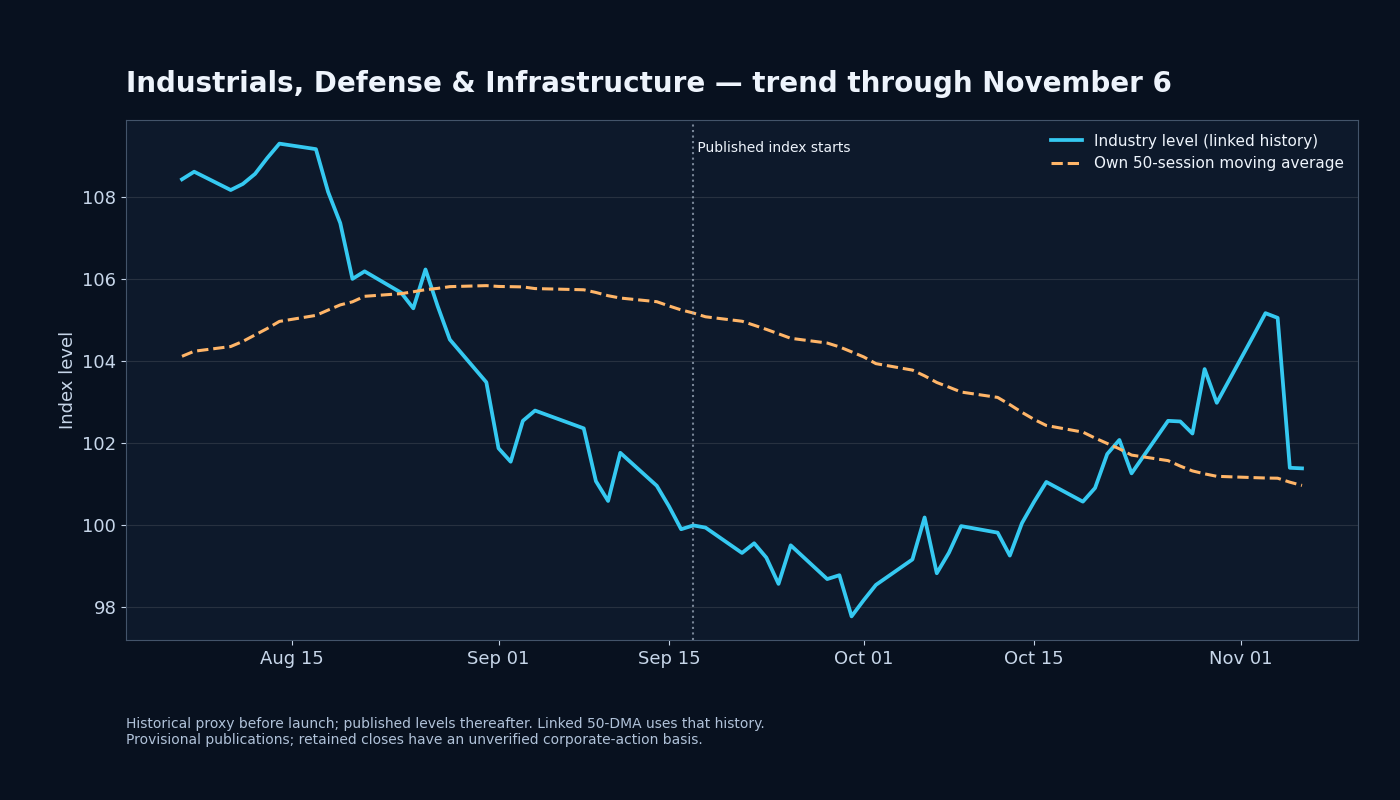
The chart distinguishes the historical proxy from the subsequent published index. Its provisional status and retained-price basis limit how confidently a single crossing should be interpreted.
Where the subindustries differ
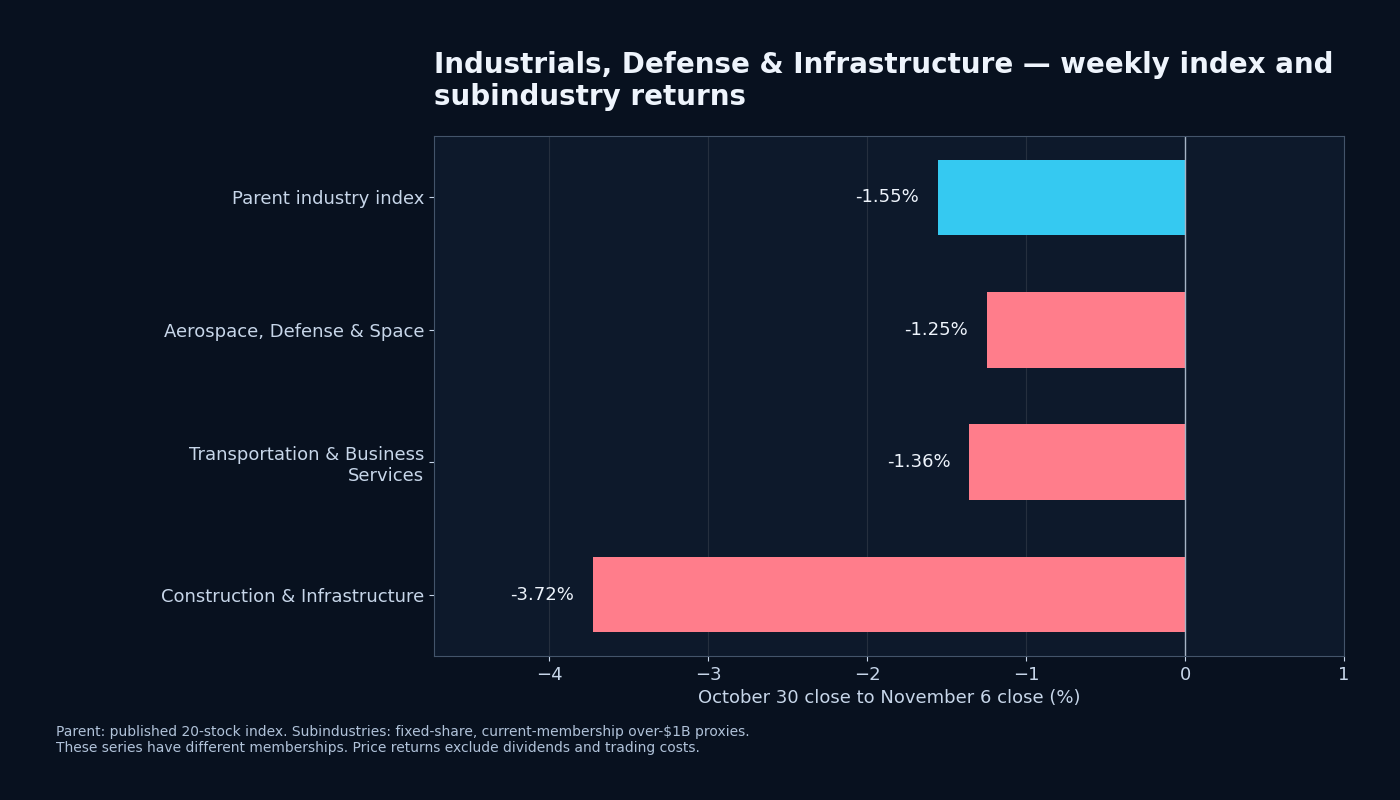
The parent index uses a selected 20-stock basket. Each subindustry comparison uses its broader eligible membership, with equal October 30 allocations and fixed shares through the week. The differences show distinct groups of businesses; they are not estimates of each subgroup’s contribution to the parent index.
Aerospace, Defense & Space. Its member-stock proxy returned -1.25%, using 56 of 57 eligible members with a complete weekly price sequence. Procurement and export headlines can matter, but election results do not immediately authorize new appropriations. A small part of the group lacks the full price history needed for this comparison. Using the remaining 54 of 56 stocks (96.4%) places the estimate 5.69% below that cohort’s own 50-DMA. This supports an estimated 3/5 next-week assessment. A score covering every weekly member remains unavailable. Excluding the sparse-history stocks changes the weekly return by 0.74 percentage point.
Transportation & Business Services. Its member-stock proxy returned -1.36%, using 156 of 158 eligible members with a complete weekly price sequence. Payroll resilience and fuel costs create offsetting demand/margin channels; airlines do not represent all transport firms. A small part of the group lacks the full price history needed for this comparison. Using the remaining 155 of 156 stocks (99.4%) places the estimate 4.40% below that cohort’s own 50-DMA. This supports an estimated 2/5 next-week assessment. A score covering every weekly member remains unavailable. Excluding the sparse-history stocks changes the weekly return by 0.00 percentage point.
Construction & Infrastructure. Its member-stock proxy returned -3.72%, using 75 of 76 eligible members with a complete weekly price sequence. Project permits, financing and PPI input costs are the channels; no quantified contract cancellation was verified. It ended 6.32% below its own moving average. That keeps recovery dependent on further technical improvement.
Company evidence to follow
BETA gained 35.26% across the reviewed week, showing how a strong individual advance can coexist with a weaker industry. This price observation does not establish a new contract, delivery milestone or earnings catalyst. Those claims require a dated company announcement; relative strength alone does not establish valuation or remove execution risk.
The November 8 public Real-Money selection includes Kanzhun and Casella Waste Systems, which the platform groups within this parent industry. Their historical October 30–November 6 gains were 6.71% and 5.23%. These moves occurred before the current selection and are not returns generated by the newly published basket.
The two businesses also illustrate why the parent label needs interpretation. Recruitment-related activity and recurring waste-services demand do not carry the same sensitivities as a shipbuilder or construction contractor. Research should connect customer activity, pricing, costs and cash generation to the actual business rather than borrow a defense or infrastructure story from the group name.
Next week’s catalysts and risks
The BLS November calendar confirms CPI on November 10 and PPI on November 13, both at 8:30 a.m. ET. These releases can shift expectations for financing, materials and labor costs. A project with committed funding may respond differently from one still seeking financing, even when the companies share an industry label.
Procurement decisions, permitting and order conversion remain practical company-level checks. Election headlines do not themselves authorize a new defense budget or establish a cancellation. This edition does not assign a quantified policy benefit to an unverified announcement. Upcoming events are opportunities for evidence, not assumed positive catalysts.
What would strengthen the case
The assessment remains 3/5, mixed, for November 9–13. Sustained support above the 100.97 50-DMA reference, together with better member participation, would be more persuasive than one strong aerospace stock. Project delays, cost escalation or renewed lows would weaken the case. The parent calculation is provisional, and unresolved price-history checks in part of the group add uncertainty to broad comparisons.